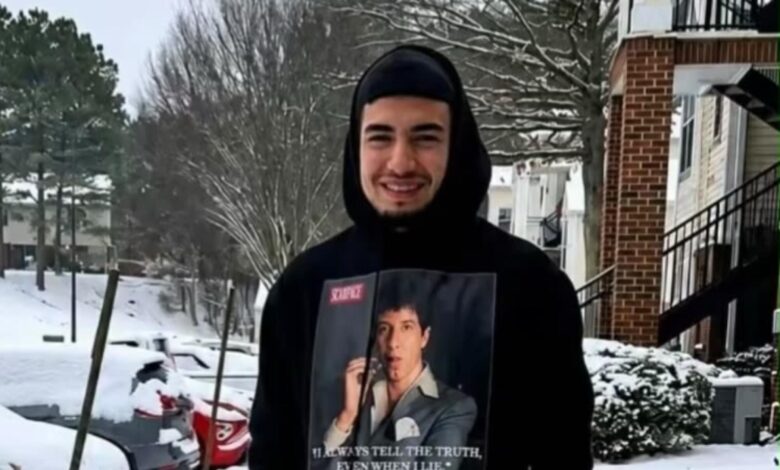
MEXICO CITY — Darwin Elizer Serrano López left Venezuela three years ago, dreaming of earning enough to put his daughters through school. He ended up in Chicago, where he drove for Uber seven days a week, pausing at 8:30 each night to call home.
When immigration agents came to his door with a deportation order, Serrano’s family was worried but also relieved to know that they would get to see him again soon. Speaking to his mother from a detention center, Serrano, 33, promised to return to Venezuela in time for his daughter’s 10th birthday on July 31.
On June 24, Serrano was put on a plane in shackles and flown from Miami to Caracas. From there, Venezuelan officials took him and dozens of other U.S. deportees to the Hotel Santuario La Llanada, a complex of buildings overlooking the ocean in the port city of La Guaira.
Hours later, when twin earthquakes struck Venezuela 39 seconds apart, the hotel shook violently, then buckled.
Serrano’s family has not heard from him since.
“We’ve looked for him in hospitals and in morgues,” said his mother, Marta Lucía López. “He hasn’t appeared.”
She is devastated to think that her son will never have a chance to enjoy the things he missed while he was abroad: dancing salsa with his wife, grilling meat with his father, sitting down with his brothers for a cold beer and a soccer game.
Then there are his kids. His 9-year-old can’t accept that her father is gone. “She keeps repeating: ‘My dad is going to come for my 10th birthday.’ That’s all she says.”
The earthquakes claimed at least 1,700 lives, with more than 5,000 people injured and many still missing.
In La Guaira, dozens of recent deportees are still believed to be trapped under rubble at the Hotel Santuario.
Many were part of the exodus of 8 million Venezuelans fleeing poverty and political repression during the 13-year rule of Nicolás Maduro, a leftist authoritarian ousted by U.S. special forces in January. Maduro’s vice president, Delcy Rodríguez, was sworn in as Venezuela’s interim leader.
Anderson Daniel Salcedo Lozano, 22, shown in an undated family photo, was rescued from a collapsed building in Venezuela but was gravely injured.
(Courtesy of the Lozano family)
Anderson Daniel Salcedo Lozano, 22, grew up amid the chaos of the Maduro years, which were marked by long lines for bread and medicine, rising infant mortality, spiraling inflation and the violent repression of protests.
He was still a teenager when he set out to earn money to help his mother build a house. He trekked 2,000 miles, passing through the jungles of Colombia and swaths of Mexico controlled by drug cartels, before eventually landing in Georgia, where he worked in construction, sent cash home and had a baby, who is now 10 months old.
Three months ago, Salcedo was detained as part of President Trump’s crackdown on immigrants who entered the country under a Biden-era humanitarian parole program.
Salcedo was on the plane with Serrano that touched down last week near Caracas, the Venezuelan capital, carrying more than 140 deportees: 120 men, 19 women, five boys and two girls. A Venezuelan official posted a video of their arrival, with most looking tired but relieved that their journey was nearing an end.
Most, if not all, were believed to have been transported to the hotel in La Guaira by the Bolivarian National Intelligence Service to undergo security checks.
Salcedo phoned his family from the hotel at 5 p.m. and said he hoped to arrive in his hometown of Nueva Bolivia, about 300 miles away, the next day. The first earthquake struck an hour later.
Salcedo was trapped under rubble for 40 hours before rescuers pulled him out alive.
At a hospital in Caracas, doctors amputated his legs. Salcedo is now breathing with the help of a ventilator and has just a 15% chance of survival, said his father, Javier Salcedo.
They were left there to die
— Javier Salcedo, father of a quake victim
The father said he spoke to another survivor of the hotel collapse who said deportees had been locked inside, and authorities had refused to open the doors even as the roof caved in around them.
“He told us that when the shaking started, they screamed to be let out because the walls were cracking,” Javier Salcedo said. “They were begging to be allowed to leave, but they weren’t permitted to exit. They were left there to die, locked inside.”
He said he is furious at the Venezuelan government for detaining migrants upon their return.
“These people were innocent, yet they were kept in custody and ultimately left to die, even as they screamed to be let out,” he said.
Other family members of the deportees were angry at officials for not doing more to help in the search-and-rescue process.
Josana Rincón has spent days in Caracas looking for her son, Carlos Blanco Rincón, 26, who also called home from the hotel.

Carlos Blanco Rincón, 26, in an undated photo, was among the Venezuelans deported from the United States the day twin earthquakes hit the country.
(Courtesy of the Rincón family)
“Mom, we’ll see each other tomorrow,” he told her.
“He sounded relieved,” his mother said. “Sad about the deportation but happy because we were going to see each other again.”
As photos and videos emerged of collapsed buildings in La Guaira, Rincón traveled across Venezuela to the hotel where her son had been held. “They told me that many people were still trapped and hadn’t been rescued,” she said. “Nobody can tell me anything about him. I’m desperate.”
Her son had worked in construction for three years in North Carolina. “He was the breadwinner,” Rincón said. “I have a 14-year-old daughter and a 22-year-old son who are still studying, and Carlos was the one who sent us money to help us out.”
She blames Venezuela’s Chavista government for mismanaging the economy and forcing her son to migrate, and U.S. authorities for deporting her son despite his contributions there.
She doesn’t think her son should have had to choose between living in poverty at home and the many risks of the migrant trail.
“He was a very upright, very honest man,” she said. “If he hadn’t gone to the U.S., he would be with us.”
Special correspondent Mery Mogollón in Caracas contributed to this report.