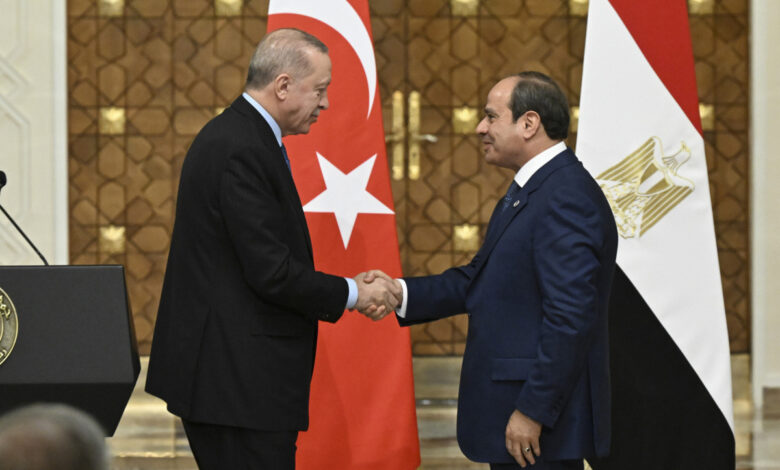
Joint air and naval exercises, military co-production projects, and growing security, intelligence and diplomatic coordination between Egypt and Turkey are taking place amid mounting regional tensions and geopolitical shifts, particularly in the aftermath of the US-Israeli war on Iran.
Developments in Egyptian-Turkish relations across multiple fronts have been significant and striking. They represent a strategic shift that could open the door to a reconfiguration of regional alliances and may signal the emergence of a defence partnership between the two countries—or even a wider regional alliance should other states join—capable of reshaping the balance of power in the region.
This growing rapprochement has reportedly raised concerns in both Israeli and American circles, amid reports that Washington has sought clarification regarding the nature of recent security and military contacts between senior officials in the defence ministries of the two countries.

Joint Air Exercises
This month saw two notable developments involving Cairo and Ankara. The first was military in nature, with joint air exercises taking place in Egyptian airspace between 4 and 17 June. Neither side disclosed details regarding the types or numbers of aircraft involved.
The second was diplomatic, namely the fourth meeting of the foreign ministers of Egypt, Turkey, Pakistan and Saudi Arabia, held this week in the Egyptian city of Alamein. The talks focused on regional issues and efforts to formulate a four-party mechanism aimed at enhancing regional security.
According to a statement by the Egyptian military spokesperson, the exercises were conducted at several Egyptian air bases and involved a number of multi-role fighter aircraft. The drills included operational training flights designed to improve coordination and enhance readiness for the execution of joint air missions under a range of conditions.
Last year, Egypt and Turkey resumed joint naval exercises in the eastern Mediterranean under the “Sea of Friendship” drills, following a 13-year pause. The two countries also signed agreements to co-produce drones, develop unmanned ground vehicles, and manufacture long-range artillery ammunition.
A landmark step in the development of military cooperation between the two countries came with Egypt’s inclusion in Turkey’s Kaan stealth fighter programme as both a development and manufacturing partner. The aircraft is expected to enter service in 2030, underscoring the expanding scope of joint defence projects and the growing military cooperation between Cairo and Ankara.
This marks the first time the two sides have agreed to elevate their cooperation to the level of producing a stealth fighter equipped with advanced technologies. Both countries hope the project will help challenge the long-standing dominance of the Israeli Air Force in the Middle East.
Meanwhile, Turkish defence company Aselsan, one of the world’s leading defence manufacturers, has recently opened a regional representative office in Egypt under the name “Aselsan Egypt”. According to the company’s chief executive, Ahmet Akyol, the move is aimed at strengthening cooperation with Egypt.
Significant Gains
Egyptian–Turkish military cooperation should be viewed within a broader context. One key dimension is Egypt’s growing attractiveness to Turkish defence manufacturers, alongside Ankara’s ambition to open new markets for its defence industry. This aligns with Egypt’s own efforts to diversify its sources of arms procurement, strengthen domestic defence production, and localise Turkish technology.
The potential gains for both countries are considerable, particularly for Egypt, which stands to benefit significantly from deeper economic and military cooperation with Turkey through increased capital flows, technology transfer and expanded opportunities for investment and employment.
Egypt is Turkey’s leading trading partner in Africa, and both countries are seeking to increase bilateral trade from approximately $9 billion to $15 billion by 2028.
READ: Report: Growing Egypt-Turkey defence ties draw Israeli and US attention
Politically and strategically, however, the issue extends far beyond economic considerations. Turkey’s aim is for cooperation with Egypt to encourage other regional states—particularly Saudi Arabia—to join this trajectory. Such a development could create a trilateral platform combining technology, production capacity and financial resources, giving the initiative greater resilience and turning it into a framework capable of delivering tangible gains across multiple sectors, according to political researcher Mohamed Abed.
A Shifting Deterrence Balance
The future value of a military partnership between Cairo and Ankara is seen as highly significant, particularly amid increasingly complex regional and international dynamics following the US–Israeli war on Iran.
In recent years, regional states have become increasingly aware of the need to build overlapping and diversified security partnerships that strengthen deterrence while reducing reliance on the United States and Western powers as primary security guarantors.
The war on Iran also exposed the vulnerability of Gulf and wider Arab security structures in the face of expanding Israeli influence. This has given renewed strategic weight to emerging understandings among the Sunni quartet—Egypt, Saudi Arabia, Turkey and Pakistan—particularly amid discussions about the possibility of forming the nucleus of an Arab-Islamic alliance capable of restoring a more independent regional balance, according to political analyst and academic Mohamed Gamal.
Speaking to Middle East Monitor, Gamal argued that expanding military cooperation between Egypt and Turkey could help ease tensions in the eastern Mediterranean and establish a new balance in energy and maritime security issues. It could also improve the prospects for political consensus in Libya, reduce the likelihood of proxy confrontations, and strengthen security in the Red Sea and the Suez Canal. More broadly, he said, it could give Cairo and Ankara greater capacity to build more cohesive regional security arrangements that rely less on external powers.
Israeli Concerns
Israeli media outlets have suggested that the joint air exercises reflect an unprecedented strategic shift, and that the rapidly developing military relationship between Egypt and Turkey presents Israel with new security challenges while reshaping regional power dynamics, particularly amid discussions about the possibility of forming a joint Arab-Islamic military alliance.
According to a military expert who spoke to Middle East Monitor on the condition of anonymity, the current relationship between Egypt and Turkey resembles an “emerging defence partnership” rather than a military alliance in the conventional sense. A formal alliance would require a mutual defence treaty, military coordination mechanisms, a joint operations centre, and clear operational and defence commitments from each side.
Those requirements have not yet been met. Nevertheless, the growing rapprochement could raise concerns in the White House, particularly from US President Donald Trump, especially if it is seen as posing any direct or indirect challenge to Israeli security. For that reason, the pace of cooperation could slow or encounter obstacles. According to Abed, the issue is not only about Washington and Tel Aviv’s ability to impede such a trajectory, but also about the seriousness of Cairo and Ankara in moving towards a genuine military alliance.
The success of this partnership, following years of political and diplomatic estrangement in the wake of the July 2013 military coup, rests on three pillars: Turkey’s policy of “zero problems” with Egypt; Cairo’s strategy of political and military repositioning; and the continued expansion of Israeli regional influence.
What has taken place on the military front between two regional powers of the scale of Egypt and Turkey—alongside progress on the diplomatic and presidential tracks under the High-Level Strategic Cooperation Council established in September 2024—amounts to a geopolitical shift that could help repair the fractures exposed by the Iran war and reshape regional power dynamics. It may also provide a broader framework for rebuilding a regional order capable of limiting the expansion of Israeli influence in the Middle East.
From a pragmatic perspective, the shared interest in preventing Israel from unilaterally shaping the region’s security agenda is likely to ensure the continuation and strengthening of Egyptian-Turkish cooperation, and may ultimately pave the way for a broader and more robust strategic alliance in the future.
OPINION: Egypt’s Family Law deepens Egyptians’ hardship
The views expressed in this article belong to the author and do not necessarily reflect the editorial policy of Middle East Monitor.