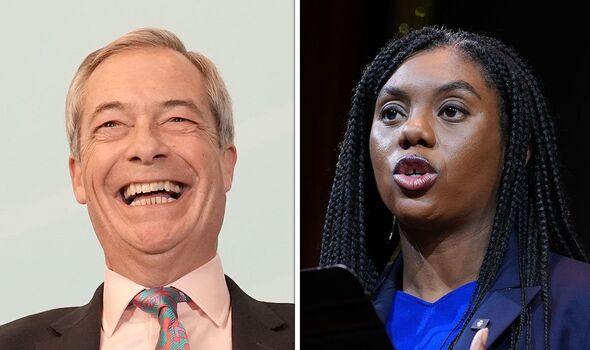
Conservative MPs and donors are urging Kemi Badenoch to consider a Tory-Reform pact before the next general election, amid fears that a split right-wing vote could help Labour stay in power. No deal has been agreed, and Badenoch has publicly ruled out an electoral pact with Nigel Farage’s Reform UK.
The pressure comes as some Conservatives argue that the party cannot win enough seats on its own if Reform continues to take votes from the right.
Supporters of a deal want the Conservatives and Reform to avoid standing against each other in selected constituencies. They believe this could stop Labour, the Liberal Democrats, the Greens or the SNP from benefiting where the right-wing vote is divided.
But Badenoch has rejected that approach.


The Conservative leader has said the two parties are “not the same” and argued that voters should not be treated like political property to be moved from one party to another.
Her position has created a clear divide inside the Conservative Party.
Some MPs believe she is right to defend the party’s identity and build support beyond the right. Others fear that refusing any arrangement with Reform could make another Labour victory more likely.
What would a Tory-Reform pact mean?
A pact would not necessarily mean a full merger between the Conservatives and Reform.
It could be a formal or informal agreement in which one party stands aside in certain seats to give the other a better chance of winning.
Another option would be a non-aggression pact, where both parties still exist separately but avoid attacking each other heavily during the campaign.
Some supporters also want tactical voting, where voters are encouraged to back whichever right-wing candidate has the best chance of winning in a particular seat. However, such an arrangement would be politically difficult.
Many Conservatives do not want to be seen as dependent on Reform. Reform also has its own support base and may not want to help the Conservatives recover after years of criticism from Nigel Farage and his allies.
Why the debate matters
The issue matters because UK general elections use the first-past-the-post system.
Under that system, the candidate with the most votes in each constituency wins the seat. They do not need more than 50 per cent of the vote.
That means two parties appealing to similar voters can damage each other if they both stand in the same seat.
Some Conservatives say this is why a deal with Reform should be considered before the next election.
One Tory MP told The Telegraph that Conservatives and Reform needed to work together to avoid splitting each other’s votes and to maximise the number of seats they could win.
Another Conservative MP said it was “absolutely essential” that the right unite because the left would do the same.
Edward Leigh, a Conservative MP and member of the right-wing Common Sense Group, also warned that two right-wing parties fighting every seat could make it easier for the left to win.
But he also said he understood Badenoch’s current approach and supported her leadership.
Sir Jacob Rees-Mogg, the former business secretary, has previously called for some form of pact to stop what he described as a very left-wing outcome.
Badenoch rejects calls to ‘unite the Right’
Badenoch has taken a firm public line against any deal. Writing in the Mail on Sunday, she argued that the Conservatives and Reform were different parties with different values.
She also said the best way to stop left-wing alliances was not to “unite the Right” but to build a Conservative majority that reaches beyond it.
That is a key point in her strategy.
Badenoch appears to believe that a pact with Reform could damage the Conservative brand and make it harder to appeal to voters outside the party’s traditional base.
Her critics inside the party see the situation differently.
They argue that the electoral maths is now too difficult to ignore and that some form of co-operation may become unavoidable before polling day. Despite the pressure, there is currently no official Tory-Reform pact.
There is also no confirmed plan for candidates to stand aside in selected seats.
Any such move would carry political risks for both parties.
For the Conservatives, it could suggest weakness and deepen internal divisions. For Reform, it could anger supporters who see the party as an alternative to the Conservatives, not a partner.
The debate is also sensitive because voters, not party leaders, decide how elections are won.
Even if parties reached an agreement, there would be no guarantee that voters would follow tactical voting instructions.
For now, the story shows the scale of concern among some Conservatives about Reform’s impact on the next election.
Badenoch is trying to hold her line and present the Conservatives as a national party that can win on its own.
But pressure from MPs, donors and senior figures shows that the question of a Tory-Reform pact is unlikely to disappear.
Readers should watch for any change in tone from Badenoch, Farage or senior figures in both parties. Until either party confirms a formal arrangement, the idea remains a political argument rather than an agreed election plan.