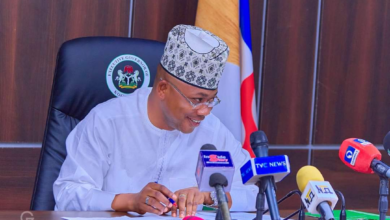
Deputy Speaker of the House of Representatives, Hon. Benjamin Kalu, has said the 10th National Assembly is deploying its constitutional powers to confront insecurity across Nigeria, describing increased funding, strict oversight, and the State Police Bill as central to the strategy.
Speaking at the Chatham House Africa Programme Roundtable in London, United Kingdom, on Tuesday on the topic: “Nigeria’s 2027 Elections: How to Ensure Electoral Integrity Amid a Deepening Security Crisis”, Kalu said security had been treated as the National Assembly’s top priority since the 10th Assembly commenced in June 2023.


The deputy speaker, in a statement by his Chief Press Secretary, Levinus Nwabughiogu, said that, through appropriation, the security and defence allocations jumped from ₦2.98 trillion to ₦5.41 trillion in the 2026 budget, representing an 81% increase in three years.
He also revealed that the House is pushing a constitutional amendment to make security funding a “first-line charge” on the national budget.
The Deputy Speaker also said that the House committees are working with the executive and security agencies to track spending and execution.
Under its representative mandate, Kalu added that the House has considered over 1,500 substantive motions between June 2023 and June 2026, noting that about 400 of them focused on security, banditry, kidnappings, attacks on farming communities, and the protection of vulnerable populations.
The motions, he said, led to concrete actions such as summoning security chiefs, mandating the recruitment of forest guards, securing commitments to protect schools in high-risk areas, and pushing for permanent security outposts in exposed communities.
He said: “Through its appropriation powers, the National Assembly has ensured that security funding has grown consistently and remains the single largest sectoral allocation in the national budget. Since the 10th Assembly commenced in June 2023, security and defence allocations have risen from 2.98 trillion naira to 5.41 trillion naira in the 2026 budget, an increase of over 81% in 3 years, and the single largest sectoral allocation for three consecutive years.
“We are also advancing a constitutional amendment to make security funding a first-line charge on the national budget, guaranteeing its release before other lines and removing it entirely from the uncertainty of discretionary timing. It will pass because protecting citizens is not a budget item that should compete for space.
“Through its oversight function, our committees have worked in partnership with the executive and the security agencies to ask the questions that strong institutions must ask of themselves. Not to find fault, but to find answers,” Kalu said.
The Deputy Speaker also told his audience, made up of policymakers, diplomats and scholars, that the National Assembly has passed the revised Cybercrimes Act 2024 and the Control of Small Arms and Light Weapons Act 2024, while advancing the Joint Doctrine and Warfare Centre Bill to better coordinate among the armed forces.
Speaking on the State Police Bill, which he described as the “legacy initiative” of President Bola Ahmed Tinubu, Kalu said the legislation, which was recently overwhelmingly passed by the House with 289 votes, would enhance the country’s security.
He argued Nigeria’s centralised police, designed before independence, cannot respond fast enough for a 923,000 sq km nation of over 230 million people.