NGO Trains Bauchi Fellows On Using Community Theatre, Storytelling To Combat Child Marriage

0
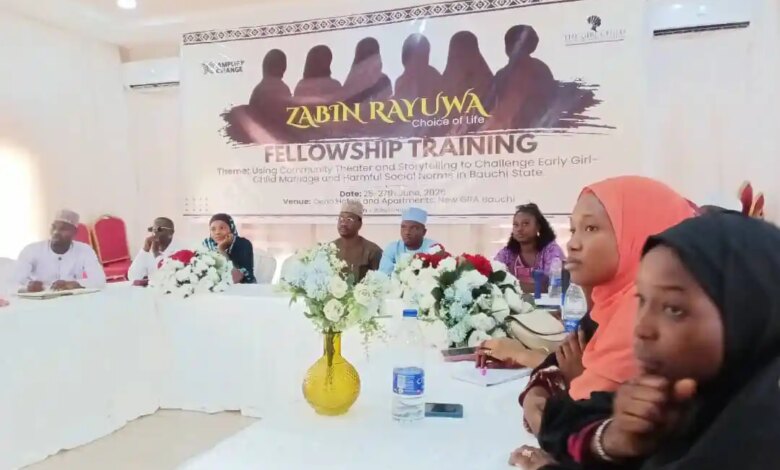
The Girl Child Value Support Initiative has trained a dedicated group of Zabin Rayuwa cohorts from all Local Government Areas (LGAs) across Bauchi State on utilizing community theatre and storytelling to challenge early child marriage and eliminate harmful social norms.
The grassroots project, known as Zabin Rayuwa, meaning “Choice to Life,” is a creative advocacy initiative targeting Northern Nigeria. It aims to end child marriage, eliminate gender-based violence (GBV), and shift deeply entrenched socio-cultural norms.
Speaking at the opening of the training at the Deno Hotel and Suites in Bauchi, Precious Samson Wakili, the Executive Director of the initiative, emphasized that lasting transformation occurs when local residents become champions of change.


“When we named this project Zabin Rayuwa, we chose those words very carefully in Hausa. It means choice in life, because every girl child deserves a choice. A choice to go to school, the choice to dream, to decide her future without fear or pressure,” She said.
Wakili noted that while this choice is taken away far too early for many girls in Northern Nigeria, the selected fellows possess the community trust and language skills necessary to drive difficult conversations with compassion and respect.
According to her, “Over the coming months, you will use theatre, storytelling, community dialogue, radio, and advocacy to challenge harmful norms. People rarely change because they are shouted at. They change when they feel seen, heard, and respected. That is why our approach is rooted in creativity and dialogue rather than blame”.
Wakili urged the fellows to work alongside traditional and religious leaders, parents, women, and youths, noting that real change happens within one conversation, one family, and one community at a time.
In a paper presentation during the training, the Creative Director of the initiative, Mr. Jacob Oluwaferanmi, outlined the core principles of community engagement and ethical communication.
He emphasized the necessity of practicing safe storytelling by protecting individual identities, obtaining explicit consent, and never forcing anyone to speak.
“Fellows should tell stories with dignity and avoid presenting people as helpless victims,” Oluwaferanmi stated.
He defined community engagement as a collaborative process where community members collectively identify problems and implement solutions.
Additionally, communication professional Hyeladzira Maryam Adamu spoke on the strategic use of theatre to address GBV, break cultures of silence, and dismantle harmful norms. Adamu explained that creative theatre serves as a collective problem-solving mechanism that builds empathy, encourages critical thinking, and establishes safe spaces for community dialogue.