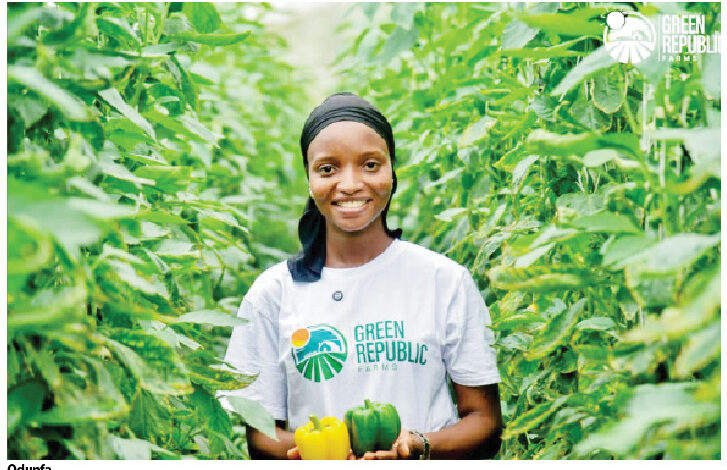
Baliqees Salaudeen-Ibrahim is the co-founder and CEO of Green Republic Farms, which leverages technology and innovation to cultivate high-quality produce like habaneros, bell peppers, and tomatoes. In this interview with ABIODUN SIVOWAKU, she reveals how using climate-smart agribusiness can end food insecurity and create jobs.
How did your journey into agribusiness begin?


My journey into agribusiness began as a climate activist and advocate. I was driven by a deep desire to solve real-world problems and create meaningful impact. This passion naturally led me to agriculture, where I saw a direct connection between climate change, food systems, and livelihoods.
I co-founded Green Republic Farms with my partners to contribute to building a more resilient food system, one that addresses food insecurity, unemployment, and the growing impact of climate change on agriculture. What started as curiosity quickly evolved into a purpose-driven mission.
Over time, I began to see agriculture not just as farming, but as a powerful tool for economic empowerment, especially for underserved communities. Today, we leverage climate-smart innovations such as solar-powered drip irrigation, controlled environment open-field farming, and greenhouse systems.
What were the early challenges, and how did you overcome them?
In the early stages of building Green Republic Farms, we faced several challenges, including limited access to funding, gaps in technical knowledge, a lack of reliable farming data, and inadequate infrastructure. There was also significant scepticism around adopting innovative farming methods such as greenhouse and soilless systems.
We overcame these challenges by prioritising continuous learning, building strategic partnerships, and starting small while reinvesting profits to grow sustainably. I actively sought mentorship, engaged with communities of practice, and embraced experimentation. These steps allowed us to refine our model and build resilience over time.
What was the turning point that changed the trajectory of your business?
A defining turning point for our business was gaining access to structured accelerator programs and funding opportunities at a critical stage of our growth. Beyond capital, these programs provided strategic direction, mentorship, and the systems thinking we needed to scale sustainably.
With this support, we were able to expand our operations, particularly by investing in climate-resilient greenhouse infrastructure, which significantly improved our productivity, consistency, and year-round production capacity.
This moment marked a clear shift from survival-driven, small-scale production to a more structured, commercially viable agribusiness. It positioned us not just for growth, but for scale, impact, and long-term sustainability.
How would you assess the impact of current government policies on MSMEs in agriculture?
Government policies in agriculture clearly aim to promote food security, youth participation, and economic growth. However, their real impact is often constrained by how well they translate into practical support for MSMEs.
One of the most critical gaps is in financing. It’s not just about access to funds, but access to the right type of financing. Agriculture requires patient, flexible, and affordable capital that aligns with production cycles, seasonality, and the inherent risks in farming. Unfortunately, many available financing options are short-term, high-interest, or structured like conventional business loans, making them unsuitable for agribusinesses.
As a result, many MSMEs are either excluded or forced into financial models that strain their operations. To truly support the sector, financing solutions must be tailored, accessible, and designed with a deep understanding of agricultural realities. Without this, even the best policies will struggle to achieve meaningful and lasting impact.
Beyond access to finance, barriers around land access, security, infrastructure, and market linkages persist. Many of these policies remain difficult to navigate, inconsistently executed, or inadequately communicated to the entrepreneurs they are meant to support.