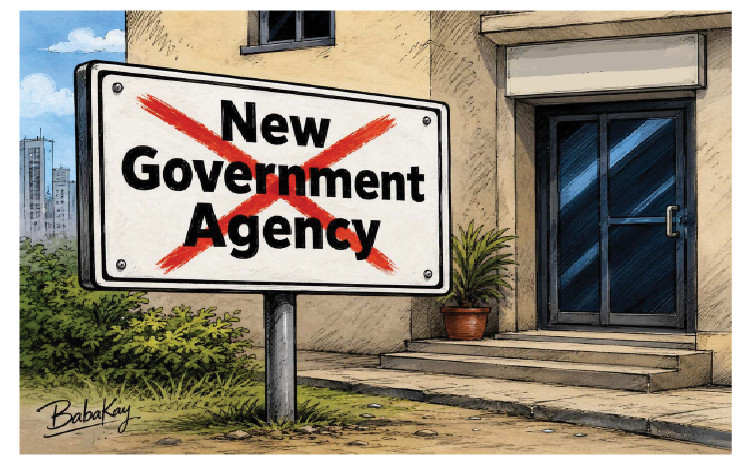
There are scandals, and then there are stories so unbelievable that your first instinct is to dismiss them as satire. When the news first broke that an allegedly non-existent federal agency — the Presidential Foreign Intervention Promotion Council (PFIPC) had not only operated from the Federal Secretariat but had a Director-General, office space, staff, official correspondence, meetings with high-profile public officials, and a budgetary allocation running into over a billion naira, many Nigerians reacted with a mixture of laughter, disbelief and exhaustion. Surely, this could not be true. Yet, the story refused to disappear.
Each day brought fresh revelations. The alleged agency reportedly had a budget code, occupied government office space, recruited personnel, and engaged with foreign ambassadors and senior government officials. It functioned with an air of legitimacy that few would have questioned. Even more astonishing was the reported provision of over ₦1.3 billion in the 2026 federal budget for an organisation the Presidency later declared did not exist.
The controversy has prompted investigations by law enforcement agencies and legislative inquiries into how such an extraordinary situation could have occurred. One could only mutter unbelievably: I beg your pardon! Unless there’s something else that we are all unaware of under the radar, time will tell hopefully.
When Reality Sounds Like Fiction
The most troubling aspect of this saga is not merely that an individual is alleged to have impersonated government authority. History is replete with audacious fraudsters whose greatest asset was confidence. What is unsettling is the apparent ease with which an elaborate ecosystem of legitimacy was reportedly constructed around the alleged deception.
An office does not materialise by itself, budgets do not ordinarily allocate themselves, government signage does not usually install itself, and official meetings with senior public officers are not typically granted to strangers without questions being asked. If the reports are accurate, then this was not simply about one individual. It raises uncomfortable questions about the strength or weakness of institutional safeguards across multiple layers of government.
Every functioning bureaucracy depends on verification. Every signature should be traceable. Every agency should have a legal foundation. Every appropriation should correspond to an entity created by law or executive authority. Every office allocation should be backed by documentation. Every appointment should leave an audit trail.
If all these processes exist, and they do, how could so many apparent checkpoints have failed simultaneously? That question should concern every Nigerian, irrespective of political affiliation. Because today it is an allegedly non-existent agency. Tomorrow it could be something far more consequential.
The Cost of Institutional Blind Spots
Nigeria has become accustomed to discussing corruption in familiar terms: inflated contracts, abandoned projects, payroll fraud and procurement abuses. This controversy introduces a different dimension altogether. It challenges our assumptions about institutional memory and administrative coherence.
How does an organisation allegedly move from imagination to apparent operational reality, reportedly obtain office accommodation, employ over 300 staff, acquire recognition from other institutions and find its way into a national budget?
None of these events occurs in isolation. Each requires interaction with another office, another desk officer, another approval, another document. The sheer scale of the reported operation is what has left many Nigerians speechless. This was not a lone individual printing business cards from a roadside shop. The reports suggest an organisation that projected the appearance of government legitimacy, complete with correspondence, engagements, personnel and physical infrastructure.
If these allegations are eventually substantiated through due process, they would expose vulnerabilities far deeper than personal misconduct. They would expose systemic complacency, and complacency is expensive.
Institutions do not collapse overnight. They erode gradually, one unchecked assumption at a time. Someone assumes another office has done the verification. Another assumes the Budget Office has validated the agency. Another assumes the Presidency approved it. Another assumes Human Resources confirmed appointments. Another assumes Security Clearance has already been completed. Eventually, everybody assumes. Nobody verifies.
The Crisis Behind the Scandal
Perhaps the most disturbing aspect of this episode is not the allegation that an individual successfully presented a non-existent institution as legitimate. It is what that possibility says about the culture of our public administration.
An office, a letterhead, a title, a budget line, a government address and official meetings appear to have been sufficient to confer legitimacy without anyone consistently asking the most fundamental question: Under what legal authority does this institution exist? Bureaucracies are sustained by process, but they are protected by verification.