‘I Deceived Nobody’ – Obasanjo Tackles Osoba, Accuses Atiku Of Funding Impeachment Plot

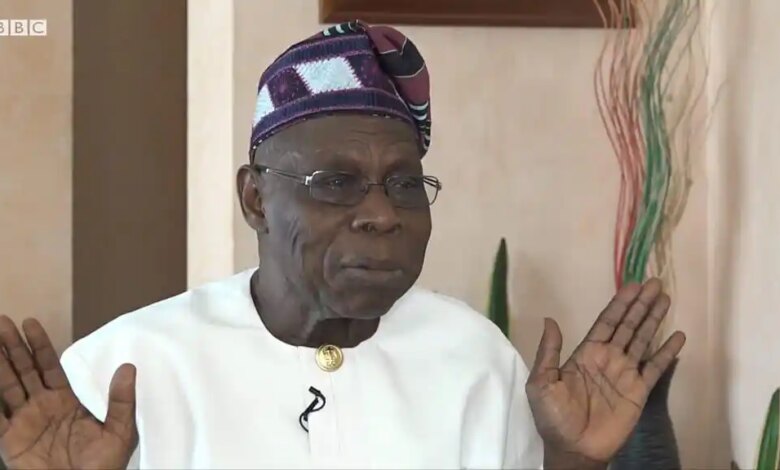
Former President Olusegun Obasanjo has rejected former Ogun State Governor, Chief Olusegun Osoba’s account of the political events preceding the 2003 general elections, insisting that he never deceived the leadership of the Alliance for Democracy (AD) or Afenifere.
Naijaonpoint reports that Obasanjo also accused his former Vice-President, Atiku Abubakar, of sponsoring an impeachment plot against him during his first term and working behind the scenes with political actors to frustrate his re-election bid.
The former President made the claims in a lengthy statement titled, “Reply to Your Inaccurate Posture: ‘How Obasanjo Deceived Us in 2003’,” in response to an article by Osoba published in The Legal Observer on July 20.
Obasanjo described Osoba’s account as inaccurate, incomplete and “farfetched”, saying several political engagements that shaped the 2003 elections were not known to the former governor.

Obasanjo said he took exception to Osoba’s suggestion that he misled the Yoruba political establishment ahead of the 2003 elections.
“I take strong and serious objection to your calling me a deceiver because I deceived nobody.
“I always presented my case and all issues as I had them and as I understood them, no matter whose ox is gored,” he said.
The former President maintained that Osoba was not privy to some of the discussions between him and senior figures in Afenifere and the AD.
“There were issues you did not know or understand because, as you pointed out, they were above your head. They were handled by your elders in Alliance for Democracy and Afenifere,” he added.
Obasanjo also defended the outcome of the 2003 governorship elections in the South-West, during which the Peoples Democratic Party (PDP) took control of five of the six states previously governed by the AD.
He maintained that the defeats suffered by the AD governors reflected the wishes of voters, although he alleged that results were manipulated in one state.
“Your loss or defeat in 2003 was genuine in all the six states except the one where the figures were successfully and murderously changed,” he said.
The former President also claimed Osoba did little campaigning before the election and later apologised to Ogun residents for what he described as an arrogant public image.
He said, “From information that reached me from the political field, you barely campaigned, and at the tail end of the campaign, you went on TV to apologise to the people for your arrogance and informed them that the starch in your agbada caused your arrogant appearance.”
Obasanjo then turned his attention to the impeachment attempt against his administration, alleging that Atiku initiated the move through the then Speaker of the House of Representatives, the late Ghali Na’Abba.
According to him, Atiku invited Na’Abba to his office while he was away on a Friday and allegedly gave him 5 million naira to begin the impeachment process.
“Na’Abba’s impeachment began at the presidency by the Vice-President, who on a Friday when I was out of the office, invited Na’Abba to his office and convinced him, as he had convinced himself and some others but of insignificant number, that I should have only one term as President,” Obasanjo alleged.
He continued, “On the Friday, he invited Na’Abba; he gave him N5 million to begin his impeachment work. It was all noted, recorded and reported to me by my Chief of Staff, a professional intelligence officer.”
Obasanjo said he treated the impeachment threat with contempt because he believed he had committed no impeachable offence.
“The game continued to be played on with me treating it with contempt as I have committed no impeachable offence except my Vice-President who wanted to take over by hook or by crook,” he said.
He added that former President Shehu Shagari later offered to intervene in the matter.
The former President further alleged that after the impeachment bid failed, Atiku pursued another arrangement involving the six AD governors in the South-West.
According to Obasanjo, Atiku wanted the governors to face no serious opposition in 2003 in return for supporting his presidential ambition in 2007.
“When he failed in the impeachment exercise, he made a two-track approach: one to go with Alex Ekwueme and Alex to hand over to him in the third year of his presidency; second is for the six AD governors of South-West not to have competition from any other party in 2003 so that in 2007, you would all yield the field to my Vice-President,” he alleged.
Obasanjo said the governors were convinced by the arrangement but failed to verify claims that he supported it.
“You were all convinced of this anti-democratic plan, and you all fell for it. I was told that I was said to be selling the idea, and if that was said of me, it was a lie,” he said.
The former President also revisited the period after his release from prison, saying he initially intended to concentrate on family matters and the education of his children.
He said he was later approached by different political delegations urging him to return to public life.
According to him, the first delegation was led by Lawan Katsina at his Ota Farm, followed by another headed by the late Chief S.M. Afolabi and a third led by the late Dr Martins Kuye.
Obasanjo said he insisted that wider consultations be conducted because some of the groups approaching him were predominantly Yoruba.
He subsequently consulted political leaders across the country before joining the PDP.
Among those he named were the late Chief Meredith Akinloye, Chief Bola Ige, Chief Richard Akinjide, Sunday Awoniyi and Adamu Ciroma, as well as Prof Oyeleye, Prof Anezi Okoro and Arthur Mbanefo.
“That quick consultation was like a sounding board. It gave me a quick and good feel,” he said.
Obasanjo stressed that political competition should not destroy personal relationships.
He cited his relationship with the late former Vice-President Alex Ekwueme, whom he defeated for the PDP presidential ticket.
“While competing with Alex Ekwueme, I was a guest in his house when I went to Anambra to campaign. We ate together, and the following morning, I went out to campaign,” he recalled.
He also spoke about his relationship with the late Afenifere leader, Chief Abraham Adesanya, saying their political disagreements never became personal.
“On three occasions, I visited Chief Abraham Adesanya, and on the three occasions, he vowed that the Yoruba would not vote for me. I never stopped calling on him to report and to campaign,” Obasanjo said.
He added that Adesanya urged him to join the AD, but he declined because he regarded the party as largely ethnic in character.
“I told him that AD as essentially a tribal party was in a cul-de-sac,” he said.
The former President also defended his decision to appoint members associated with the AD after assuming office in 1999.
He said the move was motivated by the need for national integration rather than political weakness.
“Bringing PDP and AD to join me for a sort of national government was not out of weakness; rather, it was out of strength and the unity and progress of the country,” he said.
Obasanjo said he appointed defeated PDP governorship candidates from the South-West to federal positions while also engaging influential AD leaders.
“My position was simple: the Yoruba had been in the periphery for so long; let them come to the mainstream,” he added.
Responding to Osoba’s claim that he relied on the six AD governors to stabilise his government, Obasanjo described the suggestion as illogical.
He argued that his administration had the backing of 21 PDP governors, nine governors of the then All Peoples Party, the National Assembly and the Federal Executive Council.
“Six to dictate to thirty is ridiculous. I had an Executive Council, I had a National Assembly, I had a virile political party, 21 governors and nine other governors from another party with my government,” he said.
Obasanjo maintained that although he was prepared to listen to differing political opinions, he would never surrender presidential authority to regional interests.
The former President also criticised Afenifere, accusing the organisation of failing to move beyond ethnic politics.
“Afenifere and its political party never rose beyond tribal cul de sac. There is a lesson for all in that,” he said.
He added, “If you failed to follow my line, you must be maligned and set out as an enemy. I have never believed in tribal politics.”
Obasanjo claimed some prominent Afenifere leaders later expressed regret to him over the direction taken by the organisation.
He named the late Chief Abraham Adesanya, Chief Gani Daudu and Chief Ayo Adebanjo among those who, according to him, later reflected differently on the group’s political choices.
Despite his sharp criticism, Obasanjo praised Osoba for allocating the land on which the Olusegun Obasanjo Presidential Library stands in Abeokuta.
“The greatest service you rendered for me and for Abeokuta is the land allocated for the Olusegun Obasanjo Presidential Library. It has become the most significant landmark in Abeokuta,” he said.
The former President urged Osoba to embrace humility and preserve personal relationships despite political differences.
“It is not over until it is over and there is no end to humility and thanksgiving.
“In politics, no one should be ignored or disregarded, and politics may end, relationships may live till life’s end,” Obasanjo said.