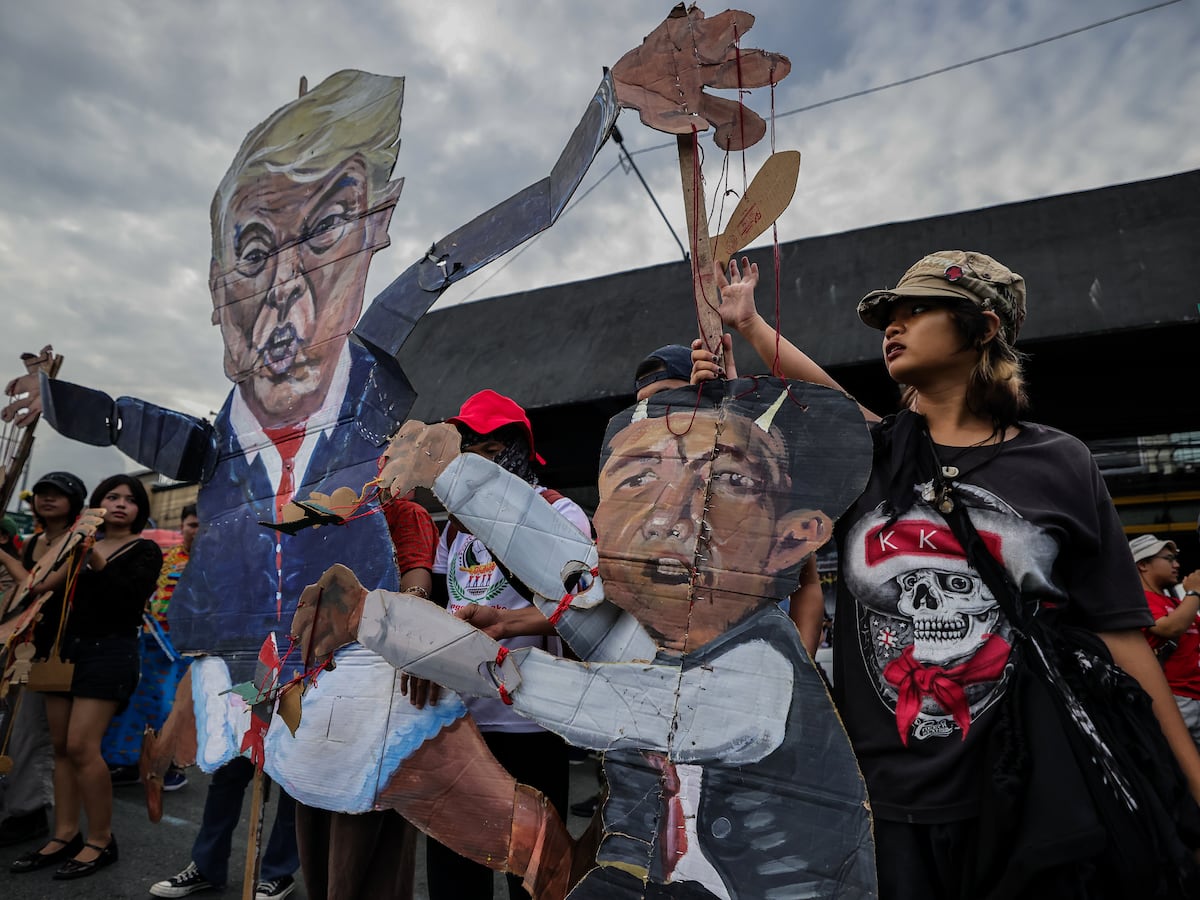
MANILA, Philippines (AP) — Philippine President Ferdinand Marcos Jr. denounced China in a veiled rebuke Monday in his state of the nation speech, vowing that his government will defend a 2016 arbitration ruling that invalidated Beijing’s expansive claims in the disputed South China Sea, and saying that Filipinos “do not yield” to conquerors.
On domestic issues, Marcos disclosed that a special anti-graft prosecutor would soon file charges against former House of Representatives Speaker Martin Romualdez, who has been implicated in a corruption scandal that the president exposed in his state of the nation speech last year.
Marcos highlighted China after media editorial he called racist


Marcos did not mention China by name or elaborate on his criticism of Beijing, which was applauded by many lawmakers. He said that “of late, our very humanity has been called into question” and reminded detractors that “Filipinos are a noble … and a great race. We are not greedy. We are not racists. We are not liars.”
Marcos summoned Chinese Ambassador Jing Quan to his office in Manila last week after the China Daily, a Chinese state-owned media outlet, depicted Filipinos as monkeys in an editorial video and cartoons. The animations centered on Beijing’s rejection of the arbitration ruling that invalidated China’s claims in the South China Sea.
The Philippine government strongly condemned the AI-generated images as “racist and dehumanizing” and demanded that they be taken down.
In Beijing, however, Foreign Ministry spokesperson Lin Jian said last week that the video “does not represent the official position and I have no comment on it.”
He said, however, that China viewed the South China Sea arbitration as “a political farce disguised as a legal proceeding.” He added that “the so-called award is illegal, null and void and has no binding force,” reiterating China’s longstanding position.
Marcos said the ruling, which he said was final and binding, was a “definitive benchmark for the interpretation and application” of the 1982 U.N. Convention on the Law of the Sea, which was the basis of the decision. The Philippines initiated the arbitration in 2013 after a tense standoff between Chinese and Philippine ships in a disputed shoal, but China refused to participate and rejected the decision as a sham.
“Your government will do all that is necessary to continue upholding this award, utilizing every peaceful and legal means available to the republic against any attempt, foreign or domestic, to undermine this achievement,” Marcos said, adding that Filipinos “do not yield.”
Territorial confrontations in the disputed waters have become more prevalent in recent years, particularly among Chinese, Philippine and Vietnamese forces and fishing fleets. The long-simmering disputes in the strategic waterway, a key global trade route, also involve Malaysia, Brunei and Taiwan.
Marcos says being family won’t protect his cousin and ally
Marcos did not identify Romualdez, his cousin and key political ally, by name but was obviously referring to him when speaking about the corruption charges to be filed.
“This is painful to me, but we have to do the right thing,” Marcos said. “I’m not a president for my family. I’m not a president for my friend.”
Romualdez, who resigned as House speaker last year but remains as a member of Congress, reiterated in a statement that he did not violate the law and he was ready to prove it.
Romualdez, along with several House members and senators, was accused of pocketing huge kickbacks from flood control projects in government and congressional investigations. Others have been charged and detained for large-scale corruption, including an incumbent and a former senator, a former public works secretary, who served under Marcos, and several government engineers and construction company executives, but to date not Romualdez.
Nearly 25 billion pesos’ ($410 million) worth of cash and properties belonging to some of the suspects have been recovered or frozen by the government and some have been returned to the national treasury, Marcos said.
Marcos suggested Philippines should now reconsider nuclear power
Marcos also spoke at length about his administration’s efforts to cushion the impact of fuel price hikes caused by the war in Iran for ordinary Filipinos. In a bid to boost energy security, Marcos said that “perhaps it is time for us to revisit nuclear energy production.”
“We will make sure it’s safe,” Marcos said, without elaborating. “We will also make sure that we can explain well to the public the good benefits of nuclear power.”
The Philippines built its first and only nuclear power plant in Bataan, a coastal province in an earthquake-prone region about 120 kilometers (75 miles) northwest of Manila, in the 1970s but it was left idle due to safety concerns and corruption.
Copyright 2026 The Associated Press. All rights reserved. This material may not be published, broadcast, rewritten or redistributed without permission.


