By Danladi Aibe
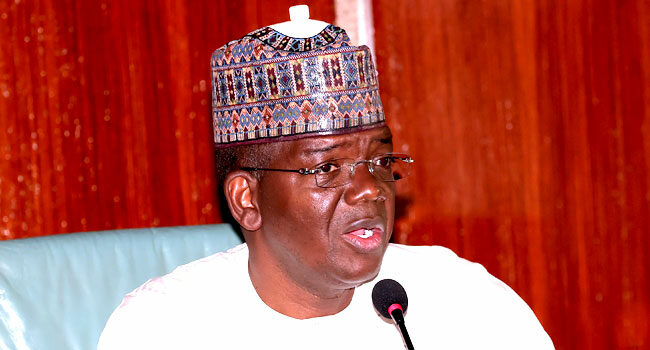
There is a certain kind of political courage that comes not from shouting the loudest, but from standing firm when the noise of cynicism is at its peak. That is precisely what Minister of State for Defence, Bello Matawalle, has done in recent weeks and Northern Nigeria, indeed the country at large, owes him a debt of gratitude for saying plainly what many quietly believe: that President Bola Ahmed Tinubu has earned the North’s support, and will earn it again in 2027.

Critics will call this politics as usual. It is not. It is an honest reading of a region that has watched roads rebuilt, security operations intensify, and its sons and daughters appointed to positions of real federal authority. Matawalle is not asking Nigerians to take his word for it. He is asking them to look around.
Infrastructure That Speaks for Itself
Start with the road – unglamorous, perhaps, but transformative. The dualisation of the Abuja–Kaduna corridor, the Zaria–Sokoto expressway, and the Ilela–Badagry route are not abstractions; they are the arteries through which Northern commerce, agriculture, and everyday life will flow for a generation. Governments are often judged by press conferences. This one is being judged, more durably, by concrete and asphalt. Matawalle’s decision to spotlight these projects is not spin it is simply pointing at what is already visible from the highway.
Security Gains the North Can Feel
Nowhere is the minister’s case stronger than on security, the issue that has defined and too often defamed the North in the national conversation for a decade. Matawalle’s account of a more coordinated, intelligence-driven approach across Sokoto, Zamfara, Katsina, Kaduna and Kebbi is not a talking point invented for an election cycle. It reflects a genuine shift in strategy, one that has, by his account, led to the neutralisation of notorious bandit leaders and the dismantling of criminal hideouts that had for years held entire communities hostage.
Perhaps most moving is the human dimension of this progress: farmers returning to their fields, markets reopening, families able to plan a future beyond survival. When a minister says relative peace has been restored in communities once defined by fear, that is not an abstraction to the people living it, it is the difference between a harvest and a hunger season. Matawalle is right to insist that this progress deserves acknowledgment rather than dismissal.
It would be easy and cheap for opposition voices to seize on isolated incidents and present them as proof that nothing has changed.
Matawalle’s pushback on this point is not thin-skinned defensiveness; it is a legitimate demand that Nigerians judge a security strategy by its trajectory, not by cherry-picked headlines. No serious security transformation happens overnight, and no honest observer should expect the North’s decade-long insurgency and banditry crisis to be solved in three years. What matters is direction, and by the minister’s account, the direction is unmistakably forward from the North-East’s counter-insurgency gains to calmer trends in the North-Central.
Representation That Reflects Reality
Matawalle’s third pillar political appointments deserves more attention than it typically receives. Whatever one’s view of Nigeria’s broader power-sharing debates, it is difficult to deny that the presence of northerners in key federal positions under this administration is a meaningful, tangible signal of inclusion rather than empty rhetoric. Matawalle is simply stating what the appointment lists already show.
The Renewed Hope Agenda, Beyond the Slogan
Skeptics have long treated “Renewed Hope” as a campaign phrase destined to fade into the archive of Nigerian political catchphrases. Matawalle’s argument is that it has become something more substantive: a framework touching agriculture, social investment, rail and energy infrastructure, and youth and women’s empowerment programmes across the North. Slogans are cheap. Sustained investment across five sectors simultaneously is not. If even a fraction of what the minister describes continues at pace, the North stands to benefit from a genuinely diversified development push — not the single-sector attention it has often received in past administrations.
Unity Over Noise