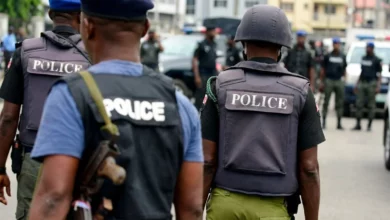
More than 15,000 police operatives, 30 commissioners of police, aerial surveillance units and armed mobile formations have been deployed across Osun State as security agencies tighten control ahead of Saturday’s governorship election.
The Nigeria Police Force (NPF) disclosed the scale of the deployment on Thursday. It said the measures were designed to secure the poll amid heightened political tension, reports of alleged vote-buying, and recent incidents of violence in parts of the state.
The Force Public Relations Officer, CSP Anietie Iniedu, said a Deputy Inspector-General of Police would coordinate the security operation, with a Commissioner of Police assigned to each of the state’s 30 local government areas.
Each local government will also have a Deputy Commissioner of Police, a Mobile Police commander, and an Assistant Commissioner of Police serving as PMF commander.
READ RELATED NEWS UPDATES
Iniedu said armed Mobile Police units had been stationed across the 30 local government areas. Each unit comprises about 60 personnel. Two additional PMF units, each with more than 60 officers, have been attached to the Independent National Electoral Commission (INEC) headquarters in Osogbo.
The police have also activated helicopter and drone operations for aerial monitoring before, during and immediately after voting.
“We will be locking down the state. We will not be allowing any vehicular movement apart from those on essential duty, security duties and those going to cast their franchise,” Iniedu told journalists in Osogbo.
The Army, he added, would close border routes into the state from midnight on Saturday, in order to restrict vehicular movement except for approved categories.
The security build-up comes against a backdrop of alleged political violence and criminal activity. Iniedu disclosed that security operatives had so far recovered about 34 illegal firearms in Osun, although he said investigations into the weapons were still in progress.
The police also announced that a mobile court would be available to handle cases involving electoral offences. Iniedu specifically warned parents to caution their children against intimidation, stalking, vote-buying and ballot-box snatching.
Vote-buying allegations surface
While security preparations intensified, residents in Osogbo alleged that political canvassers had distributed cash to voters ahead of the election.
Traders at Oja Ojude Oga, Ota Efun, Igbona, and Alekuwodo markets told journalists that they received N10,000 each from individuals who identified themselves as party representatives. One trader claimed recipients had previously received N15,000 and were promised additional payments on election day.
The trader said some people rejected the money.
A resident of Alekuwodo, identified as Silifat, also said political representatives approached residents with cash and asked them to support their candidates.
The Osun APC spokesperson, Kola Olabisi, denied that his party was involved.
“Vote-buying? Our party does not need to do that before we win. It is a popular party with a strong candidate. We are not involved, ask those in the other parties,” he said.
The Accord Party spokesperson, Oladele Bamiji, could not be reached for comment, while a message sent to him had not received a response at the time of filing the report.
INEC raises voter readiness
The Independent National Electoral Commission, INEC. It confirmed that more than 2.3 million registered voters are eligible to participate in the election, with 1,906,390 Permanent Voter Cards (PVC) collected.
INEC said the collected cards represent 81.50 per cent of the 2,339,233 registered voters in the state. The remaining 426,842 cards, representing 18.50 per cent, have been deposited with the Central Bank of Nigeria.
The commission also reported that 6,101 people who applied to replace damaged, defaced or lost PVCs printed downloadable copies of their cards.
INEC said non-sensitive materials had already been distributed to local government areas, while sensitive materials would begin moving from CBN vaults to local government offices on Friday before being transferred to Registration Area Centres.
The commission expects officials to be present at all 3,700 polling units by 8am on election day, with voting scheduled to begin by 8.30am.
INEC’s Chief Press Secretary and Media Adviser, Adedayo Oketola, said the commission had tested its electoral technology through a mock accreditation exercise. He said the Bimodal Voter Accreditation System had been configured and upgraded, while backup devices had increased from about 600 to more than 1,300.
The commission will operate situation rooms in Osogbo and Abuja to monitor polling units and maintain communication with election officials.
Oketola also cautioned political actors and voters against vote-buying, noting that both the buyer and seller could face legal consequences under the Electoral Act.
Peace accord under scrutiny
The security measures and allegations of inducement have added pressure on political parties to honour the peace agreement they signed ahead of the election.
Fourteen political parties signed the accord on July 30 under the auspices of the National Peace Committee, chaired by the Catholic Bishop of Sokoto Diocese, Matthew Kukah.
Oketola said the agreement represented a public commitment by the parties to conduct themselves peacefully before, during and after the election.
He acknowledged that political tensions had increased since INEC’s engagement with stakeholders in the state but said the commission was confident the poll would take place under adequate security.
With the police, military, and other security agencies now positioned across Osun, the focus has shifted to whether the heavy deployment, election technology, and political commitments will translate into a peaceful vote on Saturday.