The Alliance of Sahel States (AES) comprises Burkina Faso, Mali, and Niger Republic. It is a breakaway from the Economic Community of West African States (ECOWAS). There were a series of coups in the region. But the 2023 coup in Niger Republic was, indeed, a testing period for ECOWAS. It threatened military action to restore democracy. The threat was later suspended. And the rest is history, but with complications in regional security within the West African bloc.
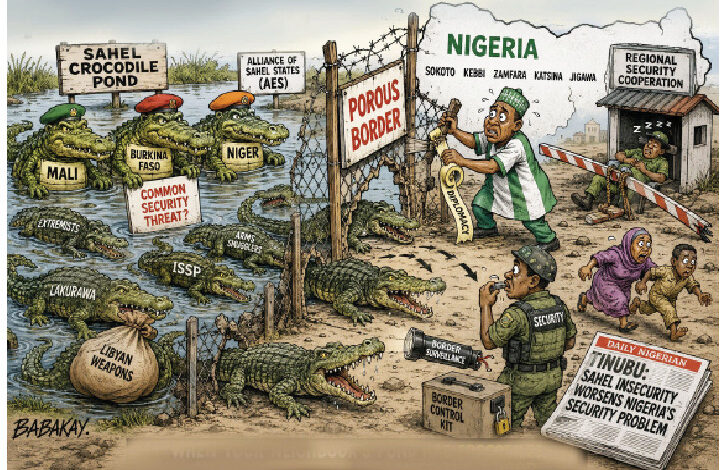
It has remained a hotspot for extremist groups because of its fluid borderlands and transnational corridors, among other socioeconomic factors. I liken the Sahel to a crocodile pond. When the crocodiles need to get some warmth, they come out to the land, and in the process, they attack any prey in sight and retreat back to the water. This analogy explains the dynamics at play between Nigeria and its Francophone neighbours in the insecurity ecosystem. Extremist groups operating on the fringes of the Sahel states easily enter and exit Nigeria because of our porous borders and vast swathes of ungoverned spaces in the North West.
Porous Borders
Sokoto, Kebbi, Zamfara, Katsina, and Jigawa share borders with the western region of Niger Republic. The Islamic State – Sahel Province (ISSP), a highly lethal transnational jihadist group, has a strong base in this region. The Nigeria border around this region is notoriously porous. For example, Birni N’Konni, a town in Niger Republic, is easily accessible from Illela town in Sokoto. The distance between both towns is roughly 18 kilometres. Illela is closer to Birni N’Konni than the distance between two area councils in the Federal Capital Territory. And the route is very fluid.
This is why extremist groups, which I figuratively labelled as crocodiles, can slip into our territory easily. The swathes of ungoverned spaces in parts of the North West serve as nesting places for these extremist groups. Historically, the Lakurawa group operates from Birni N’Konni and other towns in Niger Republic. Most instructive is the meaning of Lakurawa. It is derived from a French word meaning “les recrues” (“the recruits”), which was adapted into the local Hausa dialect as Lakurawa. It slipped into Nigeria from Birni N’Konni, Galmi, and Maradi into Tangaza and Gudu local government areas of Sokoto State.
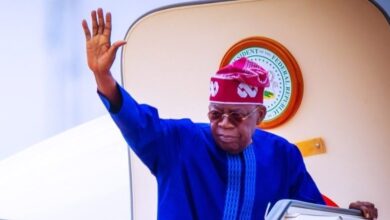
Do we recall that the first US strike in Nigeria was in Tangaza? According to findings, the strikes were targeted at ISIS-affiliated enclaves situated deep within the Bauni Forest axis of Tangaza. So, in a way, President Bola Tinubu might be right with his statement that some of the terrorists operating in Nigeria are foreigners. The President said, “the problem of insecurity in Mali, Burkina Faso, and Niger only exacerbates our difficulties.” The AES refuted it. Karamoko Jean-Marie Traoré, Burkina Faso’s foreign minister, said the Sahel countries, including Nigeria, were facing a “common security threat.” I do not agree with his position on common security threat on historical grounds.
During the 18th and 19th centuries, the Sahel experienced a wave of militant Islamic revolutions—often called the Sahelian Jihads. For example, the Massina Empire (1818) was a “holy war” led by Sékou Amadou in central Mali to establish a fundamentalist Islamic state. He banned music, alcohol, and dancing, enforcing a rigid societal structure that deeply altered local cultural fabrics. The empire lasted until it was conquered by Umar Tall of the Toucouleur Empire in 1862.
Historically, the relationship between Nigeria and its Francophone neighbours has been complex. Even though on paper there are several defence pacts, the question has been how effective these defence pacts have been. The earliest I could remember was the establishment of the Joint Task Force in 1994 by the Abacha regime, stationed in Baga, in Kukawa Local Government Area of Borno State, to checkmate cross-border armed banditry, smuggling, and crime around the Lake Chad Basin.
In 1998, it was expanded into a Multinational Joint Task Force to include troops from Chad and Niger Republic to handle shared regional border security. It was not until 2012 that the mandate included counter-terrorism. This was the era of the escalation of hostilities by Boko Haram insurgents, whose activities were aided by external forces through the porous borders of our Francophone neighbours. This piece of historical information negates the position of the AES that we share a common security threat.
Nigeria did not have a counter-insurgency manual until 2011, following the establishment of the National Counter Terrorism Centre (NCTC) and the passage of the Terrorism Prevention Act 2011. This was when the reality dawned on us that we were dealing with an alien security threat. When something is alien, it means it came from a different place. This is the correction I want to make with regard to the statement of the Foreign Minister of Burkina Faso.
The North-West of Nigeria experienced banditry and other cross-border crimes. It was more of an economic menace than an ideological one. The fall of Tripoli in 2011 unleashed a can of worms into the Sahel. Historical sources suggest that the Gaddafi regime, while it lasted, was able to suppress various rebellious groups in the Sahel. For example, he recruited thousands of Tuareg fighters from Mali and Niger Republic into his legion of armed fighters. He was able to keep at bay groups like Al-Qaeda in the Islamic Maghreb (AQMI) operating in Northern Mali since 2003.
After his fall, these Tuareg fighters returned to Mali and Niger with heavy artillery obtained from the now-unguarded Libyan armoury. In 2014, Saleh Jaweida, a Libyan member of parliament, estimated that between 10 million and 15 million light weapons up to assault-rifle level were circulating in the country, not counting heavier armaments. Even though he later stressed that the figures were speculative, it was indeed something to worry about. Most of these weapons might have found their way to the countries in the Sahel, and the heat-up has continued to this day. Were we thinking Nigeria was immune to the heat-up of the Sahel with our largely unmanned and porous borders along that corridor?
The point I want to make is that from 2012, the Sahel states were experiencing serious conflict with rebellious groups against the government for control of territories. According to historical accounts, the spill over into Nigeria was from the Liptako-Gourma region, which is the intersecting point between Burkina Faso, Mali, and Niger Republic. Illicit arms flowed seamlessly from Liptako-Gourma through southwestern Niger Republic into Sokoto, Kebbi, Zamfara, and Katsina.
It has always been a dicey situation for Nigeria with the Anglophone-Francophone divide. This is the structural fault line in West African security cooperation, and the stark reality. Ours is fundamentally a border and governance problem, not a shared ideological struggle, and it demands a border-focused response: sustained investment in surveillance, local intelligence networks, and a governed presence along the Sokoto-Kebbi-Zamfara corridor, rather than waiting on a regional consensus that history and geography suggest may never fully arrive.
The problem of insecurity in Mali, Burkina Faso, and Niger is, indeed, like a pond infested with crocodiles, and nothing restrains them from crawling out to hunt before slipping back into the water. We may not be able to drain the pond. But we can certainly guard the banks.
– Dr. Joshua Ocheja is a military historian and alumnus of the Nigerian Defence Academy.