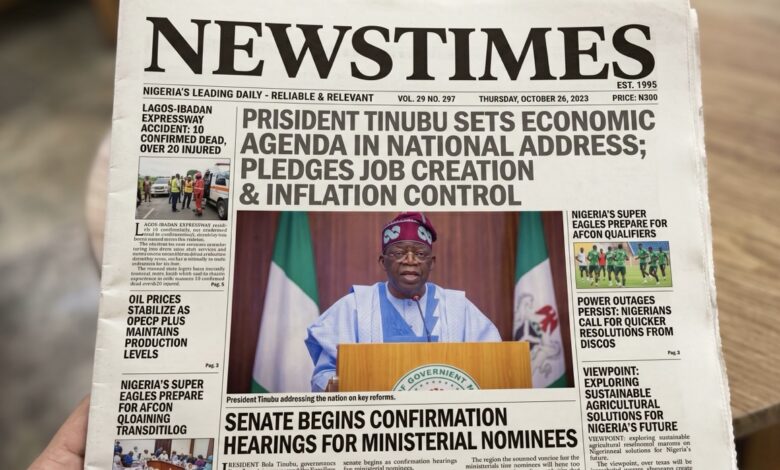
Nasarawa State Governor, Abdullahi Sule, has disclosed that he openly opposed the original Value Added Tax (VAT) component of President Bola Tinubu’s tax reform, warning that the proposed increase would have worsened the burden on Nigerians at a time of high inflation.
Sule said President Tinubu eventually listened to concerns raised by governors and allowed revisions to be made to the tax proposal.
The governor spoke on Saturday while receiving the Special Adviser to the President on Information and Strategy, Bayo Onanuga, and members of the Renewed Hope Ambassadors National Media Tour at the Nasarawa State Government House in Lafia.
Sule said he was not afraid to disagree with the President when he believed a policy could have negative consequences.
“I don’t praise-sing. When the President was misled about taxes, I criticised the matter openly,” he said.
According to him, Tinubu directed him to engage the relevant officials responsible for the tax reform and make his case.
He said, “When we visited the President, he said, ‘Sule, go and meet Zacch Adedeji and the current Minister of Finance [Taiwo Oyedele]. If you make the changes, if they agree, it’s okay.’
“I said, ‘Mr President, that’s what we wanted from you.’ Governors were pushing me that I was the one to talk, and I spoke. And when we went, we made the changes.”
The governor explained that his objection centred on the economic condition prevailing when the proposal was initially considered.
“We made the changes because as at January 1, 2025, VAT would have been 10 per cent at the time. Inflation was about 30 per cent,” he said.
Sule argued that imposing a higher VAT rate under such conditions would have increased pressure on households and businesses.
“I come from the business angle; I cannot allow our party to make a mistake. And luckily for us, we have a President who listens. He listened,” he said.
He added that the eventual changes had benefited states and improved the administration’s standing.
“We made the changes. They are positive, and it is bringing money to states; this has made the President look good,” Sule said.
Sule said supporting a political leader should not amount to unquestioning loyalty.
“There is a way that you have to be able to find a way to commend your leaders when they do right. But it goes both ways,” he said.
He also urged the presidential media team to scrutinise state governors and assess whether their development projects reflected the increased resources available to them.
“The governors should be concerned about these trips that you are making, because it is time now to be accountable,” he added.
Sule disclosed that Nasarawa State’s monthly federal allocation had increased significantly following the removal of fuel subsidy.
According to him, the state previously received between ₦3.8bn and ₦4.5bn monthly but now receives an average of between ₦14bn and ₦16bn.
“For Nasarawa State, what we were getting was anywhere between ₦3.8bn and ₦4.5bn for the state. With the removal of subsidy today, Nasarawa State is receiving an average of ₦14bn to ₦16bn every month,” he said.
The governor credited Tinubu’s reforms with freeing resources that had previously been spent on subsidy payments.
Sule also said the state had spent about ₦90bn on infrastructure without taking bank loans.
“Today, I can tell you we have spent about ₦90bn on infrastructure without borrowing one naira from the bank, and most of it has already been paid off,” he said.
Among the projects he listed were a combined overhead and underground flyover valued at ₦16.7bn, the dualisation of Akwanga Township at ₦7.1bn, an Akwanga underpass at ₦6.6bn, the dualisation of Shendam Road at ₦5.6bn, an Amba Bridge stormwater channel at ₦3.3bn and the Keffi flyover at ₦11.4bn.
Sule further said Nasarawa now hosts what he described as Africa’s largest lithium mining and processing facility.
He attributed the development to the Federal Government’s policy requiring miners to process minerals locally rather than export them in raw form.
“You cannot take away the credit from this administration,” he said.
The governor also highlighted vocational training centres offering 12 trades, post-retirement skills programmes and healthcare investments across the state’s three senatorial zones, including a specialist hospital under construction in Akwanga.
Responding, Onanuga said the media tour was intended to independently verify federal and state government development claims.
“We want to verify federal projects, verify state projects, so that people can know that the reports are not just a waste of time, but were done in good faith to really develop our country,” he said.