By Chimezie Godfrey
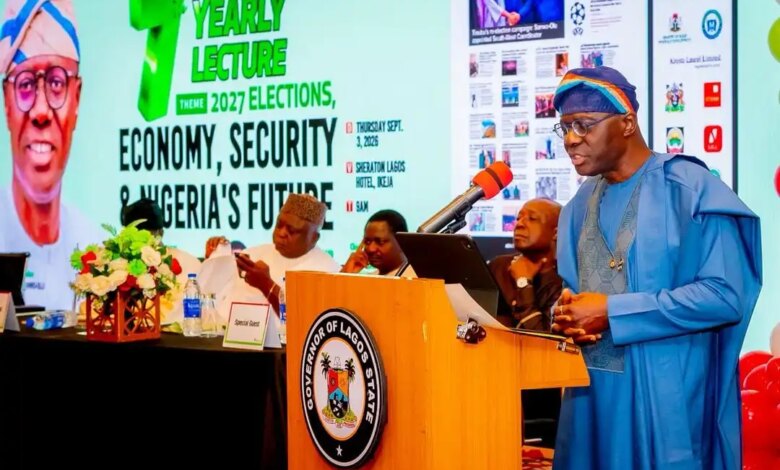
Lagos State Governor, Babajide Sanwo-Olu, has declared his support for President Bola Tinubu’s economic reforms, saying the 2027 general elections will largely be determined by the state of the economy, security and the credibility of the electoral process.
Sanwo-Olu spoke on Thursday at the Freedom Online 7th Yearly Lecture held at the Sheraton Lagos Hotel, Ikeja, where he delivered a lecture titled, “2027 Elections: Economy, Security and Nigeria’s Future.”
The governor, who said he was speaking as both a technocrat and politician, stressed that he was not seeking votes in the 2027 elections because he would be completing his second and final term in office.


He, however, declared that he expected the All Progressives Congress to retain power and President Tinubu to secure a second term to consolidate what he described as the administration’s reform agenda.
Sanwo-Olu said the removal of fuel subsidy, although painful for Nigerians, was necessary to prevent further pressure on public finances.
“I will not stand here and tell you that it has been painless. It has not. Lagosians have felt it at the pump, at the market, and in the price of a bag of rice,” he said.
But the governor argued that the economic indicators showed that the reforms were beginning to yield results.
He cited the National Bureau of Statistics’ second-quarter growth figures, saying the economy expanded by 4.43 per cent, compared with 3.89 per cent in the first quarter and 4.23 per cent in the corresponding period of the previous year.
He also pointed to growth in agriculture and services, rising external reserves, improved credit ratings, declining inflation and increased remittances as evidence of improving economic conditions.
Sanwo-Olu said Nigerians should verify the figures independently, stressing that “the difference between a case built on facts and a campaign built on fear” was evidence.
On security, the governor said insecurity would be a major factor in determining the conduct and outcome of the 2027 elections, particularly in communities affected by banditry and insurgency.
He said insecurity could affect political campaigns, the movement of electoral officials and materials, as well as voter turnout.
Sanwo-Olu commended the Federal Government for what he described as significant investments in the security architecture, including the expansion of the Nigerian Army, the establishment of a Special Operations Command by the Nigerian Navy, decentralisation of police training and the deployment of Forest Guards and Mining Marshals.
He also renewed his support for state policing, describing it as one of the most consequential reforms Nigeria could undertake.
According to him, Lagos’ experience with community-based security initiatives demonstrated the importance of bringing security closer to the people.
“The lesson of two decades is not complicated. Security works best when the people who pay for it and the people who depend on it can see, and hold to account, the people who provide it,” he said.
The governor said the economy and security were interconnected, arguing that poverty could fuel insecurity while insecurity could discourage investment and economic activity.
“When a farmer cannot go to his farm, the nation gets hungrier. When a school is not safe, the country gets another cohort of children who never learned to read,” he said.
Sanwo-Olu also highlighted programmes targeting young Nigerians, including the Nigerian Education Loan Fund, Consumer Credit Corporation and the 3 Million Technical Talent programme.
He said Nigeria’s large youth population could either become a major economic advantage or a source of instability, depending on how effectively the country creates opportunities for young people.
Turning to the electoral process, the governor said economic and security improvements would mean little if the 2027 elections were not credible.
He urged the Independent National Electoral Commission and security agencies to begin preparations early, particularly in areas vulnerable to insecurity.
Sanwo-Olu cited the August 15 Osun State governorship election as evidence that the current administration was willing to accept electoral outcomes even when the ruling party lost.
He noted that the APC candidate lost the election to incumbent Governor Ademola Adeleke, adding that President Tinubu subsequently congratulated Adeleke and commended the electoral and security authorities.
“That is what a maturing democracy looks like,” Sanwo-Olu said.
He nevertheless warned political parties and candidates against violence, saying no political victory was worth the life of a Nigerian.
“A mandate is only as strong as the process that produced it. No office in this land is worth the life of a single Nigerian, and no victory won by the wrong means is a victory at all,” he said.
The governor also urged state governors to prepare for greater scrutiny in 2027, saying voters would assess their administrations based on infrastructure, healthcare and other tangible improvements.
He argued that increased federal allocations following the removal of the fuel subsidy had placed greater responsibility on state and local governments to deliver development to citizens.
On Nigeria’s international environment, Sanwo-Olu said global developments, including oil prices, wars and interest-rate decisions by major central banks, would continue to affect the Nigerian economy.
He said the government’s responsibility was to respond effectively to such external shocks and protect livelihoods, businesses and industries.
The governor expressed optimism about Nigeria’s economic future, saying President Tinubu’s target of building a $1 trillion economy by 2030 was achievable if the country remained committed to reforms.
He urged Nigerians not to view the 2027 elections as a battle for the survival of democracy, saying the country had built enough democratic resilience to look beyond successive election cycles.
Sanwo-Olu said he expected the APC to win the 2027 elections and President Tinubu to secure a second term, but stressed that the election must be peaceful and credible regardless of the outcome.
He also challenged the media to play a stronger role in protecting the electoral process by fact-checking claims, exposing disinformation and giving adequate attention to women and young people participating in politics.
“I am not asking for a compliant press. A compliant press is of no use to a democracy; it flatters the powerful and abandons the public. I am asking for a rigorous press,” he said.
The governor urged journalists to scrutinise claims from all political camps, including his own party, warning that anonymous social media accounts and manipulated videos would pose significant challenges during the election season.
He said the 2027 election should not merely be remembered as another election Nigeria survived but as a milestone in the country’s democratic development.
“Let 2027 be remembered not as the election Nigeria survived, but as the election at which Nigeria came of age,” Sanwo-Olu said.
What do you think about this?
Drop your opinion in the comment section.
FOLLOW US & Share this with someone who needs to see this.