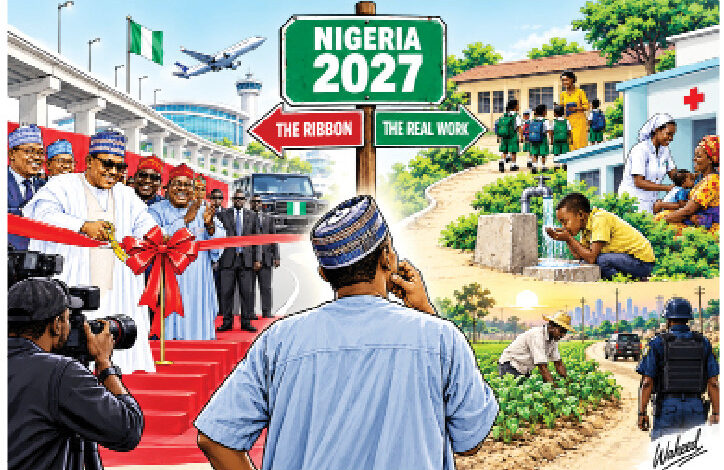
Nigeria’s 2027 campaign is acquiring its familiar shape. Billboards will multiply. Commissioning ceremonies will assume the choreography of state occasions. Governors and ministers will present flyovers, airports and freshly paved roads as proof that government has worked. In the political marketplace, concrete photographs well: it gives achievement a shape, a price tag and a ribbon to cut.
A flyover is easy to display. A child who can read because her teacher is trained and present is harder to put on a billboard. A grand hospital can be unveiled; a ward clinic that quietly prevents maternal deaths rarely commands a live broadcast. Drainage, safe water and sanitation are almost politically invisible. Yet they often matter most.
Beyond the Politics of Concrete
The coming campaign must therefore force one question into the open: what should count as successful government? The answer cannot be the number of contracts awarded, structures commissioned or kilometres announced. Government must be judged by whether people became safer, healthier, more capable, more productive and more dignified.
Election seasons encourage commissioning politics: development reduced to projects that can be branded, televised and converted into campaign material. But a ceremony proves only that a structure exists. It does not prove that the structure solves the right problem, serves enough people, works reliably or can be maintained.
The serious questions begin when the cameras leave. Does the road connect productive communities or merely beautify a privileged corridor? Is the secretariat improving public service, or housing the same inefficiency in a costlier building? Can the hospital recruit staff and stock medicines? Is there a recurrent budget for the airport? A project without purpose, operation and maintenance is not transformation. It is an unfinished sentence.
This matters because states now command greater fiscal space. Fiscal federalism cannot remain a quarrel about how much money leaves Abuja. It must become a compact about what states deliver. More resources must produce more measurable and enduring public value.
That discipline must govern accountability. Nigeria’s problem is not simply a shortage of projects, but a surplus of announcements and a deficit of execution. Projects are funded, abandoned and rediscovered in another election cycle. Publishing budgets and audited accounts matters, but disclosure is only the threshold. Citizens should know not merely what was spent, but what worked; not merely what was completed, but what remains operational; not merely the contract value, but the value delivered.
The Foundations That Matter
Basic education exposes the poverty of a construction-only idea of government. Classrooms matter, but a classroom without a competent teacher, books, water, toilets and measurable learning is only partially a school. Nigeria’s learning crisis is an economic emergency unfolding slowly. Children who cannot read, reason or calculate today will enter tomorrow’s labour market already excluded from much of its opportunity.
The meaningful education scorecard for 2027 is therefore not how many blocks were erected. It is whether literacy and numeracy improved; whether teachers were present and effective; whether children attended, progressed and completed school; and whether inspection produced correction. A governor who builds fewer classrooms but enables more children to learn may leave the greater legacy.
Healthcare demands the same lens. For most families, the health system is not the gleaming specialist hospital in the capital. It is the primary healthcare centre in the ward, where a pregnant woman should receive antenatal care, a child should be immunised, and an infection should be treated before it becomes an emergency. A beautiful clinic without staff, medicines, water or electricity is architecture, not care.
Water and sanitation reveal another contradiction. No city is modern if taps are dry, refuse chokes the streets and the first serious rain turns roads into rivers. Flood prevention is not emergency relief; it is urban governance. Drainage, wetland protection, waste collection, building code enforcement, and responsible land use are the hidden engineering of a functioning city.
Nowhere is the moral claim clearer than in the Niger Delta. The question of communities bearing the environmental cost of Nigeria’s petroleum economy cannot be answered with intermittent clean-ups and promises. Remediation must be measurable: what is contaminated, what is being restored, who is responsible and how livelihoods will recover. A federation cannot distribute oil revenues while socialising pollution among host communities. Ecological responsibility is part of fiscal justice.
Security governance is equally vulnerable to theatre. After an attack, vehicles are purchased, checkpoints appear and emergency meetings are convened. Some responses are necessary, but activity is not architecture. A serious state asks where crime concentrates, which roads, waterways or forests enable it, what patterns preceded attacks, how intelligence travels from communities and who is accountable for prevention and response.
The objective is not to react impressively to the last crime, but to prevent the next one. Crime reduction, safer highways, faster emergency response and better intelligence are outcomes; patrol vans, uniforms and meetings are inputs. Confusing them leaves citizens paying an insecurity tax: farmers abandon fields, transporters avoid routes, shops close early and investors choose elsewhere.
Jobs are the other infrastructure Nigeria urgently needs. Young people do not chiefly require another empowerment slogan. They need skills, electricity, finance, connectivity, secure transport and a regulatory environment in which enterprise can breathe at scale.