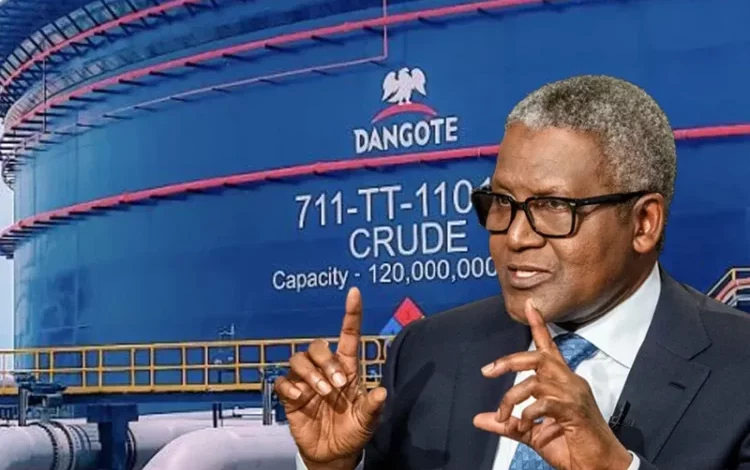
The Dangote Petroleum Refinery has sought to ease concerns over the impact of falling crude oil prices on its profitability, saying its returns are driven mainly by refining margins rather than the absolute cost of crude.
The reassurance came as Dangote Industries Limited seeks to attract millions of Nigerians to its ongoing initial public offering, with prospective investors weighing the refinery’s earnings prospects against movements in the international oil market.
Vice-President of Dangote Industries Limited, Devakumar Edwin, gave the explanation on Friday during a media tour and briefing at the refinery.
Edwin said a decline in crude prices after the current US-Iran conflict would not automatically translate into weaker refinery profits.


He likened the model to ordinary trading, where a seller’s margin is determined by the difference between purchase and selling prices rather than the purchase price alone.
“The crude price will not directly have an impact on profitability,” Edwin said.
He explained that when crude prices rise, the prices of refined products typically adjust in the same direction. A fall in crude prices would similarly affect product prices, thereby leaving the refinery’s focus on the margin between its input and output costs.
Edwin, however, disclosed that the geopolitical conflict could temporarily create an additional earnings boost for the refinery.
He attributed the potential increase not to the price of crude but to disruptions in the supply of refined petroleum products.
According to him, some refineries in the Middle East have faced difficulties securing crude and maintaining normal production levels. Reduced exports from the region have also tightened supplies in the international products market.
“When the war is on, there could be a little bit of extra profitability now. It is not because of crude, but because product movement is affected,” he said.
Edwin acknowledged that such an advantage would fade when supply conditions normalise. He said the refinery’s long-term financial projections were based on the economics of its $20bn investment rather than temporary gains caused by geopolitical disruptions.
“We are on target as far as that is concerned,” he said.
Refinery promises dollar dividends
The Dangote executive also disclosed that dividends from the refinery would be paid in dollars, citing the facility’s export earnings as the source of the foreign exchange.
He said about half of the refinery’s current production was being exported, while the planned expansion would increase its export capacity significantly.
“As a company, we believe that there is going to be a very good value appreciation. There will be very good returns in terms of dividends. And my president has even declared that the dividends will be in foreign exchange, in dollars,” Edwin said.
The company is targeting at least 10 million shareholders through the public offering. Edwin said the minimum subscription was set at N5,250 to make participation accessible to Nigerians across different income groups.
He also said Dangote Industries deliberately waited until the refinery was completed, commissioned and operational before offering shares to the public.
According to him, prospective investors therefore have access to the facility’s operating record rather than investing solely in a project still under construction.
Edwin disclosed that the refinery’s expansion is targeted for completion within three years, although the company expects that timeline could be shortened.
He said the second phase would cost less than the original project because existing infrastructure, including port facilities, a granite quarry and a welding gases plant, would not need to be replicated.
The expansion will also introduce petrochemical facilities, including a linear alkyl benzene plant and a propane dehydrogenation unit.
Edwin said the necessary licences had been obtained, basic engineering had been completed and most detailed engineering work was nearing completion, with equipment orders and major contracts already underway.
He added that the refinery would use blending where spare processing capacity made it commercially sensible, but would favour direct crude processing where that offered stronger margins.
The company’s pitch to prospective shareholders therefore rests on several factors, including refining margins, export earnings, planned capacity expansion and the potential for foreign-currency dividends, rather than on crude oil prices alone.
READ RELATED STORY
Dangote IPO demand surges as investment platforms struggle
Sanusi sets limits on Dangote IPO rush
Dangote: Border price gap keeps petrol smuggling profitable