Nigeria has taken its push to move vulnerable households from emergency assistance towards longer-term resilience and self-reliance to the United Nations General Assembly in New York, as millions of people continue to require humanitarian support.
Minister of Humanitarian Affairs and Poverty Reduction Dr Bernard M. Doro used a high-level side event at the 81st UN General Assembly to argue that humanitarian assistance should not end with short-term relief but should help households recover, build livelihoods and eventually become less dependent on government or donor support. The ministry’s 25 September statement described the goal as moving people “from vulnerability to shared prosperity”.
The policy message comes against a difficult humanitarian backdrop. The United Nations estimates that 5.9 million people in Borno, Adamawa and Yobe states will require humanitarian assistance in 2026, while Nigeria’s Humanitarian Needs and Response Plan is seeking $516 million and prioritising 2.5 million people considered to be in the most acute need.
That gap between the scale of need and available resources helps explain why the Federal Government is increasingly arguing for a system that combines emergency relief with social protection, livelihoods and economic inclusion.

Doro says humanitarian support must lead to self-reliance
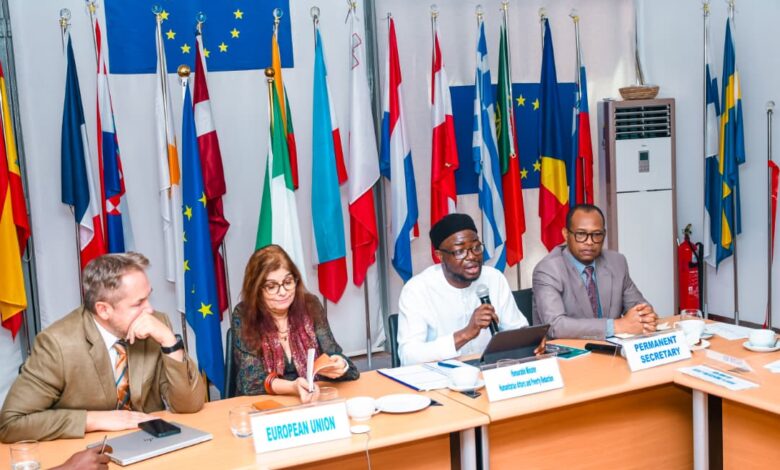
The UNGA side event, titled “Beyond Assistance: Reducing Poverty, Advancing Protection and Building Shared Prosperity”, was held on 24 September at the United Nations headquarters in New York.
It focused on how humanitarian response, poverty reduction, migration and social protection could be linked more closely instead of operating as separate interventions.
Ahead of the event, Doro said Nigeria’s objective was to ensure that humanitarian assistance became a route towards recovery rather than a permanent cycle of crisis support.
“Our message at UNGA 81 is simple: humanitarian assistance must save lives, but it must also become a bridge to recovery,” he said ahead of the meeting.
The ministry’s subsequent statement said vulnerable households needed credible routes towards resilience, self-reliance and shared prosperity.
The gathering was organised with development partners including the International Organization for Migration and Innovations for Poverty Action. The ministry also listed IQS and the Learning Economic Foundation among the participating organisations.
Nigeria’s Minister of Foreign Affairs, Ambassador Bianca Odumegwu-Ojukwu, and Women Affairs Minister Imaan Sulaiman-Ibrahim were among senior Nigerian officials linked to the discussions. The Foreign Affairs Ministry confirms that Odumegwu-Ojukwu has served as Nigeria’s Foreign Affairs Minister since her elevation to the position in 2026.
The event also received a message from UN Deputy Secretary-General Amina Mohammed, represented by Mohamed Yahya, while IOM Deputy Director-General for Operations Ugochi Daniels was among the international participants identified by the ministry.
What ‘beyond assistance’ could mean for vulnerable households
For ordinary Nigerians, the important question is how the policy shift changes what happens after someone receives immediate assistance.
Nigeria has traditionally operated several humanitarian and social-protection interventions through different agencies and programmes. The challenge has been how to connect emergency food support, cash transfers, social registers, livelihoods and longer-term poverty reduction without repeatedly assisting the same households while others are missed.
One of the ministry’s wider reforms is the One Humanitarian, One Poverty Reduction System (OHOPRS), which it says is intended to improve coordination, reduce duplication and use household-level data to track whether beneficiaries move from vulnerability towards greater economic stability.
The ministry has also placed greater emphasis on Nigeria’s social registry as a tool for identifying vulnerable households and limiting duplication between government interventions. Doro tells World Bank social registry is key to poverty reduction
Why measurable results will matter
The UNGA statement sets out the government’s policy direction, but it does not provide new figures showing how many households have already moved permanently out of poverty as a result of the approach, nor does it announce a new funding package or provide new programme-level outcome measurements.
That distinction is important.
Moving from emergency assistance to sustainable poverty reduction requires more than changing programme language. Progress would need to be demonstrated through measurable indicators such as household income, employment, food security, school attendance, access to health services and reduced dependence on repeated emergency support. The wider humanitarian environment also makes implementation difficult.
The UN says international humanitarian funding for Nigeria has been shrinking. Its 2026 plan prioritises only 2.5 million of the estimated 5.9 million people requiring humanitarian assistance in the three North-East states because available resources are insufficient to reach everyone.
The UN has consequently argued that Nigeria will increasingly need nationally led and nationally financed humanitarian systems, supported rather than primarily operated by international organisations.
That position broadly matches Doro’s argument in New York that short-term humanitarian interventions need to be connected to longer-term national systems.
What happens next
The main test will be whether the approach announced internationally translates into measurable changes for households inside Nigeria.
That means tracking whether beneficiaries who receive cash transfers, livelihood assistance or other social protection subsequently experience sustained improvements — rather than measuring success mainly by the number of people who received assistance.
It will also require coordination between federal and state governments, development partners, humanitarian organisations and agencies responsible for social investment.
Related news
Doro advocates unified poverty-reduction system to harmonise Nigeria’s interventions
Social registry database is key to ending poverty, Doro tells World Bank team
Doro launches initiative targeting 50 million Nigerians out of poverty in five years
What readers should know
Doro’s UNGA message represents a shift in emphasis from counting how many people receive humanitarian assistance towards examining whether support actually helps households recover and become more self-reliant. But the New York statement does not itself establish that poverty has fallen as a result of the approach. With 5.9 million people estimated to need humanitarian help in Borno, Adamawa and Yobe in 2026, the key test will be whether the government’s reforms produce measurable household improvements and whether sufficient funding and delivery systems are available to sustain them.