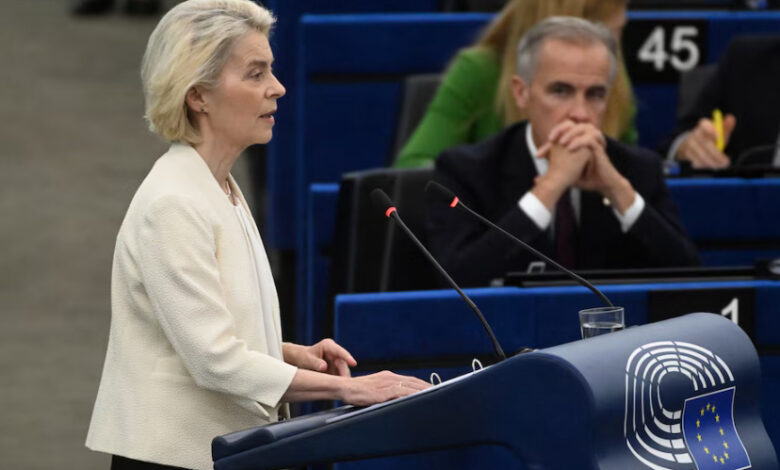
The European Union has opened the door for Canada to become its first-ever “associate member”, European Commission President Ursula von der Leyen announced on Wednesday, signalling a major expansion of the relationship between the two sides.
Von der Leyen made the proposal during her annual State of the European Union address at the European Parliament in Strasbourg, where Canadian Prime Minister Mark Carney was present.
“I would like to work with you on opening the door for Canada to be the first associate member of the EU,” von der Leyen told Carney during her address.
She said the European Union needed to rethink how it builds international partnerships as geopolitical and economic pressures increase.


“We must urgently reimagine our partnerships,” von der Leyen said, adding that Europe and Canada “see the world with the same eyes” on issues ranging from artificial intelligence and climate change to the Arctic, geopolitics and the war in Ukraine.
The proposed arrangement would establish a new relationship between the EU and a country outside the bloc. However, associate membership is not currently a legal category under the EU treaties, meaning that the proposal would require further discussions over its structure, rights and obligations.
The proposal comes as Canada and the EU seek to strengthen economic and strategic cooperation. Their existing relationship includes the Comprehensive Economic and Trade Agreement, while cooperation has also expanded into defence, technology, critical minerals and other strategic sectors.
Von der Leyen said the EU wanted to take the relationship to a higher level, with closer cooperation expected in areas including energy, artificial intelligence, quantum technology, cybersecurity and defence.
The Arctic is also expected to become an important area of cooperation because of Canada’s geographic position and the region’s growing strategic importance.
Carney has previously described Canada’s desired relationship with Europe as a “unique alliance”, while making clear that Ottawa is not seeking conventional full membership of the European Union.
READ RELATED STORY
European leaders condemn Trump tariff warning in Greenland standoff
Tinubu heads to Europe for three-week leave ahead of 2027 campaign
Moldova’s pro-European party wins majority in parliamentary election
The proposed associate status would therefore represent a different model, allowing Canada to deepen its relationship with the bloc without becoming a full EU member.
The announcement also comes as Canada seeks to broaden its international economic partnerships amid continuing trade tensions with the United States. Carney has been pursuing closer relations with Europe as Ottawa looks to reduce its dependence on its largest trading partner.
Von der Leyen said the EU-Canada relationship could be built around shared interests rather than directed against any particular country.
The two sides are expected to continue discussions on the proposal, with an EU-Canada summit scheduled for later in October providing an opportunity to develop the idea further.
For now, Canada remains outside the European Union, and no formal associate-membership agreement has been concluded. The announcement instead marks the beginning of discussions over what could become an unprecedented new form of partnership between the EU and a non-member country.