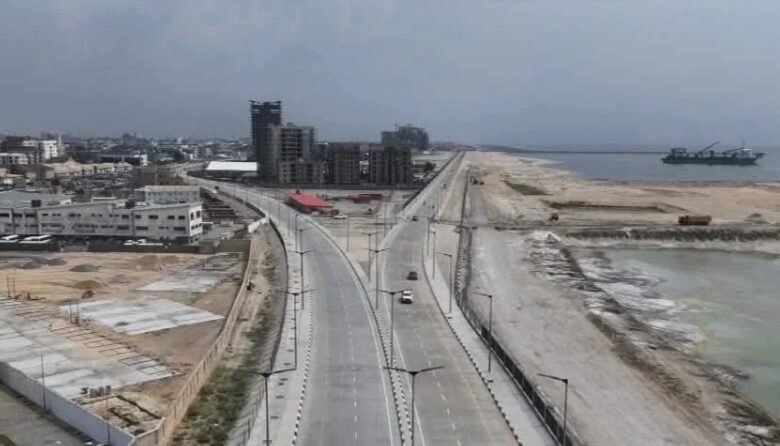
The Federal Government (FG) has given motorists and other road users on the Lagos section of the Lagos-Calabar Coastal Highway two weeks to comply with safety rules or face closure of the route.
The Federal Controller of Works in Lagos State, Olufemi Dare, issued the ultimatum on Monday during an inspection of the highway, citing speeding, vandalism, illegal parking and other activities that have created safety risks along the corridor.
Dare said the directive came from the Minister of Works, David Umahi, following repeated breaches on a road that is still under construction.
“Within two weeks, if there’s no improvement on all these issues, then we have no option than to come back and shutdown this road,” he said.


The controller explained that the government could redirect motorists to the Lekki-Epe Expressway if the coastal highway has to be closed.
He also pointed out that the Lagos section was opened to traffic before the completion of several major structures, particularly bridges. The stretch covers about 103 kilometres and is divided into two sections. Section One spans roughly 47 kilometres, while Section Two covers about 56 kilometres.
There are 20 major bridges across the two sections, with 10 located in each section. Several are still being constructed, making speed control particularly important around active work zones.
Dare said the prescribed speed limit on the highway is 30 kilometres per hour. He expressed concern that some motorists had been travelling at speeds as high as 120km/h despite ongoing construction.
“We have said your speed on the coastal road must not be more than 30 kilometres per hour,” he said.
The controller also disclosed that fatalities had been recorded frequently along the route. He said the government could not overlook the danger posed by motorists who ignore the restrictions while construction workers operate around the road.
Truck and trailer operators also came under scrutiny. Dare said some articulated vehicles had been using parts of the highway as temporary parking areas, creating additional hazards for other road users.
The government has also prohibited illegal U-turns, commercial motorcycles, tricycles, hawking and animal grazing on the route. Dare said anyone caught making unauthorised U-turns would be prosecuted.
The restrictions extend to shanties and other illegal structures along the highway, which officials consider a security concern as well as an obstruction to the construction corridor.
Security deployment is being strengthened as part of the response. Dare said the Federal Government had reached an understanding with the Lagos State Police Command to increase the number of officers stationed along the highway following meetings between Umahi and the state Commissioner of Police, Fatai Tijani.
“Beginning from this morning, we’ve started to see the improvement in deployment of police. And we are going to have more,” Dare said.
Vandalism has emerged as another major problem. According to Dare, about five kilometres of ClearVu fencing has been removed, while approximately 18 kilometres of concrete covers have been vandalised and carted away.
He said the fencing was being dismantled at night after it had been installed to separate nearby communities from the highway.
The Federal Controller said the government was considering concrete barriers in vulnerable locations because the steel fencing could be removed more easily. He added that CCTV cameras were also being considered to improve surveillance.
The authorities are further preparing a community-based security arrangement. Dare said approval had been given for the recruitment of 40 coastal guards for Section One, with four persons expected to come from each community along that stretch.
The guards will work with the police and provide local surveillance, while another batch is expected to be recruited for Section Two.
Dare said some previously deployed coastal guards had been attacked by vandals, prompting plans to reorganise and retrain the personnel under the supervision of the Lagos State Police Command.
The two-week deadline therefore places the highway’s continued public use on compliance with several conditions at once: speed control, lawful driving practices, protection of road infrastructure, proper use of the carriageway and stronger security around construction zones.
If the Federal Government finds insufficient improvement after the two-week period, Dare said the Lagos section could be shut and traffic redirected to the Lekki-Epe Expressway.
READ RELATED NEWS UPDATES