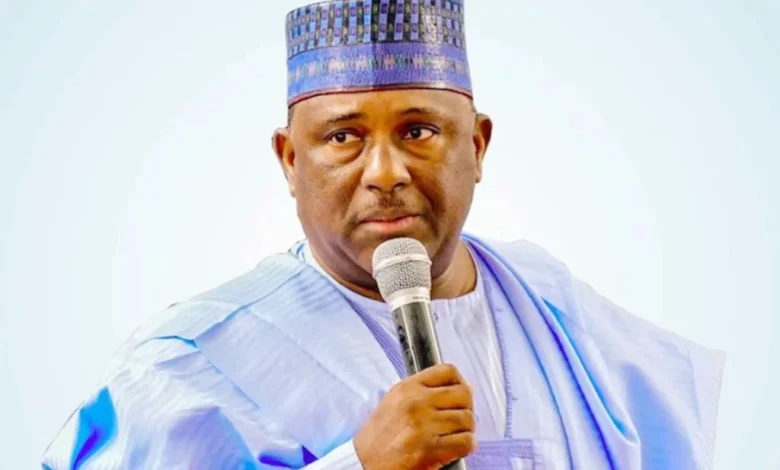
He is a gem and an industrialist who has distinguished himself by consistently investing and expanding despite Nigeria’s harsh economic climate. Through BUA Group, he has deepened manufacturing, strengthened local production, created jobs, built infrastructure, delivered shareholder value and advanced philanthropy, demonstrating enduring confidence in Nigeria’s future. Abdulsamad Rabiu is the Person of the Year 2026.
In difficult economic periods, the true measure of business leadership is often revealed. While some enterprises flourish only when conditions are favourable, others demonstrate their strength when inflation rises, currencies weaken, costs soar, and uncertainty prevails. Abdulsamad Rabiu unmistakably belongs to the latter class – a businessman whose significance lies not merely in the wealth he has created, but in his capacity to build, expand and endure when the environment offers every reason to retreat.


At a time when Nigerian businesses have been confronted by inflation, exchange-rate volatility, high energy costs, weakening consumer purchasing power and an increasingly expensive cost of capital, Rabiu has continued to make a compelling case through action: that Nigeria remains worth investing in, worth building in and capable of producing globally competitive industrial enterprises.
For scaling Nigerian manufacturing, creating employment, deepening local production, investing in critical infrastructure, delivering value to shareholders, and sustaining an expansive commitment to social development despite formidable economic headwinds, Abdulsamad Rabiu, chairman of BUA Group, is the 2026 Person of the Year.
The honour recognises not only the success of a collection of companies but also a philosophy of enterprise rooted in a fundamental conviction: enduring wealth is created not merely by trading on opportunities, but by building the productive capacity upon which economies grow.
In 2026, that philosophy was once again evident.
While many businesses responded to Nigeria’s difficult economic climate by postponing investments, scaling back expansion or retreating into survival mode, BUA continued to build. Under Rabiu’s leadership, the group intensified its investments across manufacturing, food production, logistics and infrastructure, committing substantial resources to projects designed not only to enlarge its commercial footprint but also to strengthen the productive architecture of the Nigerian economy.
Among its major commitments was approximately $85 million for the expansion of BUA’s Port Harcourt terminal. In an economy where the cost of moving goods can be nearly as high as the cost of producing them, investment in logistics is a significant intervention in the broader challenge of competitiveness.
But the industrial expansion extended well beyond the ports.
Across the food value chain, BUA continued to invest in wheat milling, sugar refining, edible oils, feed milling and noodles manufacturing. These sectors are at the heart of everyday Nigerian life. The ability to produce essential goods locally has implications for food security, employment, foreign-exchange conservation and price stability.
Rabiu’s wager has stayed the same: Nigeria cannot import its way to industrial prosperity.
The country must produce more of what it consumes, process more of its agricultural output, deepen domestic supply chains, and create enterprises capable of competing at scale. That conviction underpins BUA’s expansion story.
In cement, additional capacity came online, adding millions of metric tonnes to the domestic supply. For a country facing a vast infrastructure deficit and a persistent housing challenge, the availability and affordability of building materials are matters of considerable economic importance. Greater production capacity strengthens the ability to meet demand, supports construction and eases supply-side pressures.
BUA Cement has continued to consolidate its position as one of the defining industrial enterprises on the Nigerian Exchange. Even in a challenging macroeconomic environment, the company maintained its relevance through increased production, operational improvements, and new capacity, while remaining a key driver of long-term shareholder value.
This relationship between industrial expansion and investor reward is central to understanding Rabiu’s achievement.
The modern corporation serves multiple constituencies. It must satisfy customers, reward investors, create employment, support communities, and remain sufficiently competitive to survive. Balancing these interests is among the most demanding tests of corporate leadership, and the BUA model has sought to meet this challenge.
As BUA Foods expanded its sugar and flour operations, it strengthened its position as a major force in Nigeria’s consumer goods sector. The company’s growth reflected confidence in its expansion strategy and its capacity to navigate rising costs while building stronger domestic supply chains.
BUA Cement and BUA Foods have also remained key symbols of indigenous corporate capacity. Their scale and market significance demonstrate that Nigerian-owned enterprises can achieve the sophistication, reach and commercial relevance of the world’s most successful industrial businesses.
Yet the numbers alone do not capture the full meaning of Rabiu’s industrial project.
Behind every new production line are engineers, technicians, machine operators, accountants, distributors and countless others whose livelihoods are directly or indirectly tied to industrial activity. Behind every factory lies an ecosystem of suppliers, contractors and service providers. Every expansion creates a chain of economic opportunities extending far beyond the company itself.