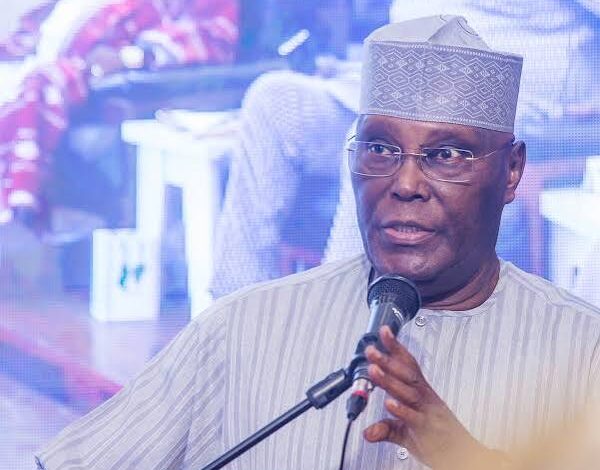
Former Vice President Atiku Abubakar has accused the President Bola Tinubu administration of creating an illusion of economic prosperity by celebrating rising naira-denominated revenues while Nigerians contend with currency depreciation, inflation, declining purchasing power and mounting public debt.
Atiku, in a statement issued on Wednesday by his Senior Special Assistant on Public Communication, Phrank Shaibu, argued that the Federal Account Allocation Committee (FAAC) figures being celebrated by the government do not necessarily translate into increased economic value or improved living standards.


According to him, the increase in monthly allocations must be assessed against the declining value of the naira and the rising cost of goods and services.
“The arithmetic is brutal,” Atiku said, comparing FAAC distributions in 2019 with those of 2025.
He claimed that FAAC distributions stood at approximately ₦7.85 trillion in 2019, equivalent to about $25.6 billion at the prevailing exchange rate, while the figure had risen to approximately ₦21.9 trillion by 2025 but was worth only about $14.6 billion in dollar terms.
Atiku said the figures showed that although the nominal naira allocation had almost tripled, its corresponding dollar value had fallen by more than 40 per cent.
“That is not an economic miracle. That is money illusion,” he said. “You cannot batter the currency, allow inflation to ravage purchasing power and then wave bigger naira figures before Nigerians as evidence that the country has become richer.”
He argued that the same phenomenon was evident in the earnings of Nigerian workers, using the minimum wage as an example.
According to Atiku, the ₦30,000 minimum wage introduced in 2019 was worth approximately $83 at the time. He said that by May 2023, its dollar equivalent had fallen to about $65, while the current ₦70,000 minimum wage, at an exchange rate of about ₦1,320 to the dollar, was worth roughly $53.
Atiku said the comparison illustrated what he described as the administration’s “money illusion”—a situation where nominal income increases while the purchasing power of the income declines.
“The figure in your hand is bigger, but the value in your pocket is smaller,” he said.
He added that workers could earn more naira and still struggle to afford basic necessities such as food, transportation, electricity, medicine and housing.
Atiku also questioned the continued indebtedness of state governments despite what he described as unprecedented FAAC revenues.
He cited a September 2026 report based on Debt Management Office data, claiming that 12 states whose governors are approaching the end of their tenures have a combined debt burden of approximately ₦5.3 trillion, consisting of about ₦2.16 trillion in domestic debt and $2.33 billion in foreign obligations.
The former vice president said the figures raised questions about how increased government revenues were being deployed.
“If the states are swimming in unprecedented revenues, why are they still drowning in debt?” he asked.
Atiku argued that increased revenue should ultimately be measured by its impact on infrastructure, debt repayment, public services and citizens’ standard of living rather than by the size of government allocations.
“Revenue is not an achievement merely because it enters a government account,” he said. “The achievement is what that revenue buys, what debts it settles, what infrastructure it delivers and how much better it makes the lives of the people.”
He further criticised what he described as selective application of fiscal discipline, calling for government expenditure, tax concessions, import waivers, revenue exemptions, duplicated projects, abandoned projects and other areas of potential waste to receive greater scrutiny.