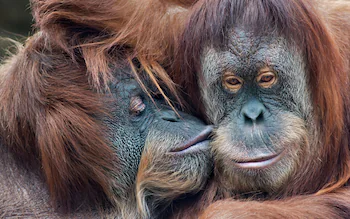
Scientists from the University of Oxford have won a 2026 Ig Nobel Prize after developing a scientific definition of kissing and using it to investigate how far the behaviour stretches back through human evolution. Their research suggests kissing may have existed in the common ancestors of great apes millions of years ago — and that Neanderthals probably kissed too.
Dr Matilda Brindle and Professor Stuart West of Oxford, working with Catherine Talbot of the Florida Institute of Technology, received the Ig Nobel Prize for biomechanics at a ceremony in Zurich, Switzerland, on 3 September.
The Ig Nobel Prizes are not the same as the Nobel Prizes awarded in fields such as physics, chemistry and medicine. They celebrate unusual research that is intended to make people laugh before making them think seriously about the science behind it.
The Oxford-led team’s challenge began with what might seem like a simple question: what exactly counts as a kiss?


To study the behaviour across different species, researchers needed a definition precise enough to distinguish kissing from feeding, grooming or aggressive contact.
Their resulting definition centred on non-aggressive mouth-to-mouth contact between members of the same species, involving movement of the mouth or lips but no exchange of food.
Kissing may be millions of years older than humans
Once they had established their definition, the researchers compared observations of kissing-like behaviour across primates and other animals.
Their analysis concluded that kissing is found among most living great apes and may have been present in their common ancestors between about 16.9 million and 21.5 million years ago.
That would make kissing far older than modern humans.
The research also suggests that Neanderthals probably kissed, although scientists cannot directly observe the behaviour of an extinct species and therefore cannot state this as an established historical fact.
One piece of supporting evidence comes from research indicating that Neanderthals and early humans exchanged oral microbes. Scientists say that finding is consistent with saliva being exchanged between the two groups, although kissing is not the only conceivable explanation.
Brindle said it would be surprising if Neanderthals did not kiss given the behaviour seen among chimpanzees, bonobos, orangutans and other primates.
She told NPR that kissing appears to be an ancient behaviour rather than something invented by modern humans, adding that its long evolutionary history suggests it may serve a useful biological or social function.
Scientists are still investigating exactly why kissing evolved.
Possible explanations include helping individuals assess potential partners, strengthening social bonds or allowing an exchange of microbes. The current research does not establish one definitive evolutionary purpose.
New Daily Prime has previously examined the importance of investment in , including the substantial research resources available to institutions such as Oxford.
Unusual research dominates 2026 Ig Nobel awards
The kissing research was only one of several unconventional studies recognised at this year’s awards.
Scientists were also honoured for research into cockroach milk, the science of nose-blowing, splash-resistant urinals and using buried underwear to measure the biological activity of soil.
The economics prize went to researchers whose experiments examined whether people from higher social classes were more likely to engage in unethical behaviour, including taking sweets that had been set aside for children.
Another team buried around 1,000 pairs of underwear in more than 25 countries to investigate soil health. The rate at which the cotton material decomposed offered researchers information about biological activity underground.
The 2026 ceremony was also significant because it was the first time the Ig Nobel event had been held outside the United States.
Organisers moved the ceremony to Zurich after raising concerns about international researchers being able to travel to the US. Future events are expected to rotate through European locations, with Antwerp in Belgium scheduled to host the 2027 ceremony.
The Ig Nobels have traditionally been associated with institutions including Harvard University and the Massachusetts Institute of Technology, although the awards themselves are organised by the Annals of Improbable Research.
For broader New Daily Prime coverage of universities, research and academic achievement, readers can also see its reporting on and .
What readers should know
The Oxford team’s Ig Nobel Prize does not prove that scientists witnessed Neanderthals kissing. The conclusion is based on evolutionary comparisons between living primates and other biological evidence. What the research does suggest is that kissing could be an extremely ancient behaviour, potentially dating back more than 20 million years and existing long before modern humans emerged.
Read related news:
2025 Nobel Prize winners: Who they are and what they achieved
Machado hands Nobel peace prize medal to Trump
White house blasts Nobel committee after peace prize snub for Trump