She Got a Job From a Friend’s Referral, And the Company Moved Her Family Abroad — 1000 Ways to Japa

Someone you know has left or is planning to leave. 1,000 Ways to Japa speaks to real people and explores the endless reasons and paths they take to japa.
When Opemipo got laid off five months after moving to Sweden for work, Finland wasn’t part of the plan. In this story, she shares how her friend referred her for a life-changing role, how the company handled her full relocation to Sweden without her spending a kobo, and the one piece of advice she’s giving anyone in this job market.
I left Nigeria in February 2022 for Sweden, but I now live in Finland
Before the move, I was actually doing really well in Nigeria. I had built a life and a career that I was proud of. I was growing, learning, and beginning to feel like I was finding my place in my career.


Then life took a beautiful turn. I got married in 2019, and in 2020, I had my daughter – right at the start of the COVID lockdown. Becoming a mother changed a lot for me. Suddenly, I was thinking not just about my career, but also about the kind of life and opportunities I wanted for myself and my growing family.
Around that time, I started looking into remote opportunities. I remember interviewing with Opera Mini/Opay, and at one point, I received an offer. But because I was pregnant, the offer was eventually rescinded. Honestly, that was difficult. It felt like I was being penalised for something that was such a beautiful and important part of my life.
But that experience didn’t stop me. I kept looking, and sometimes, the opportunities you don’t get make room for the ones you were actually meant to have.
A friend of mine, Kevwe, eventually referred me for a remote Project Coordinator role. I got the opportunity and joined in 2021. At the time, I didn’t realise just how significant that moment would be. That role became the beginning of a completely new chapter for me – one that would eventually take my career and my family in a direction I never could have imagined.
About six months into the job, something completely unexpected happened: the company was acquired by Klarna, the Swedish buy-now-pay-later company.
At the time, there were only about a few of us working remotely from Nigeria. We were settled into our roles and getting on with our lives, so the acquisition was already a big change in itself. But then came another surprise.
Because of GDPR requirements, Klarna couldn’t continue having us work remotely from Nigeria. Instead of simply ending our contracts, they decided to relocate us.
I remember how surreal that felt. I had only recently found my footing in this new remote career when I was suddenly told I might have the opportunity to move to Europe.
I hadn’t planned for it. Moving abroad wasn’t something I had been actively pursuing at that point. But sometimes, life opens a door you weren’t even looking for, and you have to decide whether you’re brave enough to walk through it.
Not at all, honestly. Moving abroad wasn’t really part of some big, carefully planned “japa” strategy.
My husband is a British citizen, and around that time, with the economy the way it was, we had quietly started exploring our options. We talked about possibly moving to Scotland or somewhere else in the UK. Nothing was certain – we were just having conversations, looking at possibilities, and praying about what the right next step would be for our family.
And then, completely out of nowhere, the company was acquired.
Suddenly, an opportunity arose to relocate to Sweden. Sweden wasn’t even on our radar. We had been thinking about the UK, and here we were being offered a completely different path to Europe.
Looking back, it was one of those moments where you just have to pause and say, “Okay, God, I see what you’re doing.”
We had been praying for a way forward, but we were imagining one thing, and God opened a completely different door. We didn’t plan for Sweden. We didn’t even see it coming. It just happened.
So, for me, it really did feel like one of those “God did this” moments. What we thought would require years of planning and figuring everything out somehow came together through an unexpected opportunity.
Honestly? Almost nothing on our end. Looking back, I realise just how incredibly favoured and blessed we were.
Klarna partnered with a consultant to handle almost the entire relocation process for us. They took care of the documentation, visas, and all the complicated paperwork that comes with moving to another country.
The consultant verified our marriage certificate, checked our academic records, and made sure all our documentation was legitimate and in order. We didn’t even have to provide proof of funds. In fact, there was very little we had to figure out ourselves.
We had just one appointment in Abuja, and after that, everything moved incredibly quickly. It was honestly surreal because I kept thinking, “Is this really happening?”
When we arrived in Sweden, Klarna also covered our relocation costs and paid for our first month’s rent. They even arranged for a relocation specialist to help us find permanent accommodation.
So, in many ways, we didn’t have to navigate the relocation process alone. The company took care of the things that would normally be some of the most stressful parts of moving abroad, and we were able to focus on preparing ourselves and our daughter for this completely new chapter.
It was a very different experience from what I had imagined relocating to another country would be. There was still a lot of uncertainty and emotion around leaving Nigeria, but having that level of support made the transition so much easier.
Yeah, I know, right? But there’s a catch.
So when I got to Sweden, I moved from project coordinator to scrum master in my original team, but I didnt think the role was challenging enough, so I pushed to move into a role within an existing Klarna team. The thing is, there’s usually a 2-year waiting period before contractors are fully integrated into Klarna’s workforce, but I skipped that since I was already working at a company that Klarna owned. When I moved over, I was treated like a brand-new employee.
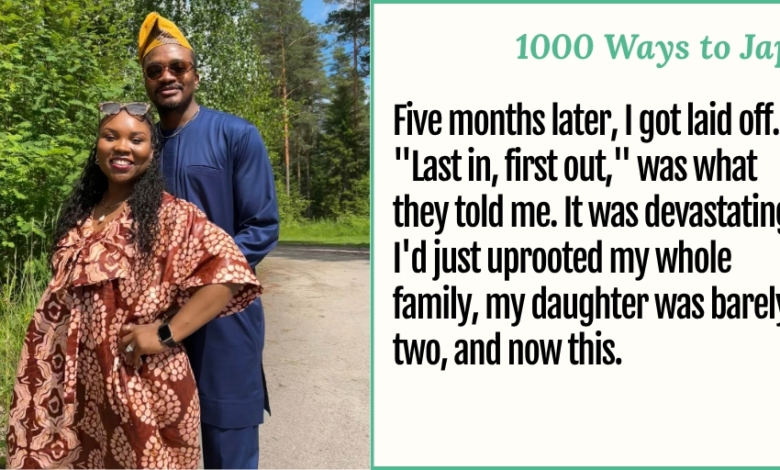
Five months later, I got laid off. “Last in, first out,” was what they told me. It was devastating. I’d just uprooted my whole family, my daughter was barely two, and now this.
Honestly, what came next was probably the most depressing period of my life.
The excitement of relocating to Sweden had faded, and suddenly I found myself dealing with a completely different reality. I had moved my life and my family to a new country, and now I was facing uncertainty about my career and what would happen next.
Thankfully, Swedish labour law gave me a bit of a safety net. Because I still had my original employment contract from before the Klarna acquisition, I was entitled to six months’ salary upon my termination.
And that turned out to be incredibly important.
In Sweden, your residence permit can be tied to your employment, so losing your job also meant I had to think carefully about how much time I had to find another one. That six months of salary effectively gave me around nine months of breathing room, rather than the three months I would otherwise have had to find new employment.
I remember being very deliberate about how I wanted the money paid. I told them, “No, please don’t pay it as a lump sum. Pay me monthly.”
I needed that structured income. I needed to know that every month, I could still pay our bills while I focused on finding another job.
Looking back, that period was incredibly difficult emotionally. I had gone from feeling like everything was falling perfectly into place, moving to Sweden through what felt like a God-ordained opportunity, to suddenly wondering what I was going to do next. But that six-month salary gave me something I desperately needed at the time: time. Time to breathe, time to figure things out, and time to look for my next opportunity without immediately having to panic about how we were going to survive.
I knew I couldn’t sit around feeling sorry for myself. I was on LinkedIn every single day. I took online courses, attended Swedish language classes, reached out to Nigerians working at companies I was interested in, and asked for referrals, interview tips, and advice. I was willing to learn, adapt, and do whatever I could to find my footing again.
But one of the biggest things that carried me through that period was the Nigerian community in Sweden. People I had never met were willing to help me simply because they understood what it meant to be starting over in a new country.
What do you think about this?
Drop your opinion in the comment section.
FOLLOW US & Share this with someone who needs to see this.