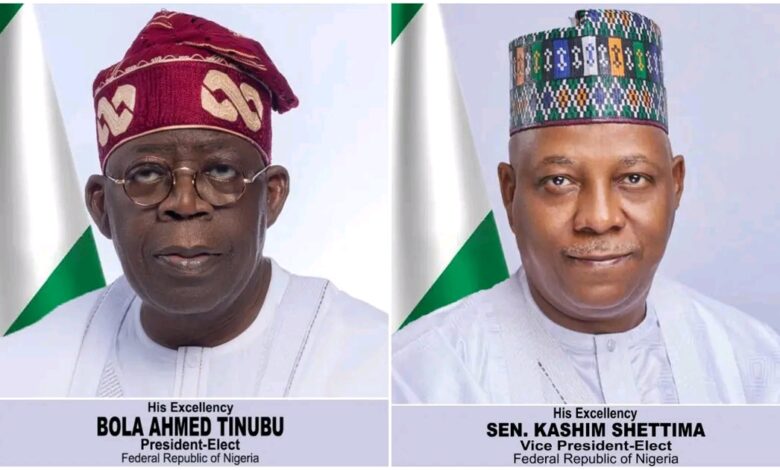
President Bola Tinubu’s extended working vacation in France and Vice-President Kashim Shettima’s official assignment at the United Nations (UN) General Assembly in New York have opened a fresh debate over the exercise of presidential authority in Nigeria.
Tinubu left Nigeria on August 30 for a working vacation, travelling first to London before moving to Paris. The Presidency announced on September 21 that he had extended the trip by a few days and was expected back in Nigeria at the weekend.
Shettima, meanwhile, departed Abuja on September 20 to lead Nigeria’s delegation to the 81st UNGA, where he is scheduled to deliver the country’s national statement and hold high-level engagements.
The unusual overlap has revived attention around Section 145 of the 1999 Constitution, which sets out the procedure for a temporary transfer of presidential functions.

Under the provision, a President proceeding on vacation or otherwise unable to discharge the functions of office is required to transmit a written declaration to the President of the Senate and the Speaker of the House of Representatives. Until another declaration is issued, the Vice-President performs the President’s functions as Acting President.
The Constitution also provides a 21-day mechanism. If the President fails to transmit the declaration within that period, the National Assembly may, through a simple majority in both chambers, mandate the Vice President to perform the presidential functions as Acting President.
That provision was introduced through the 2010 First Alteration to the Constitution following the constitutional difficulties surrounding the prolonged absence of former President Umaru Yar’Adua.
Yar’Adua left Nigeria for medical treatment in Saudi Arabia in November 2009 but did not transmit the required declaration. As his absence continued, then Vice President Goodluck Jonathan was unable to formally assume presidential powers.
The National Assembly eventually invoked the doctrine of necessity on February 9, 2010, after 78 days, to recognise Jonathan as Acting President. The episode subsequently influenced the constitutional amendment that established the present written-notification and 21-day arrangements.
The current situation is different in one important respect. Tinubu has not ceased to hold office, and Shettima has not assumed the office of President. Section 146, which deals with an actual vacancy arising from circumstances such as death, resignation, impeachment or permanent incapacity, therefore does not automatically apply merely because both office holders are outside Nigeria.
The immediate question is instead whether the temporary transfer mechanism under Section 145 has been activated and, if so, how presidential functions are being handled while Shettima is also abroad.
The Presidency has maintained that there is no leadership vacuum. In its September 21 statement, it said Tinubu had continued to communicate with officials at home and direct government affairs during his working vacation.
The State House cited the President’s directive establishing an independent panel to investigate the deaths of 37 suspected illegal miners in Niger State as one example of his continuing engagement with domestic affairs. It also said Secretary to the Government of the Federation, George Akume, would continue representing the President at some official functions while Shettima attends the UNGA.
READ RELATED NEWS UPDATES
Tinubu goes on annual leave
Tinubu heads to Europe for three-week leave ahead of 2027 campaign
Tinubu, Shettima absent: Akpabio says he is not acting president
Tinubu had also specifically mandated Shettima to represent him and lead Nigeria’s delegation to the UNGA.
The arrangement has nonetheless attracted questions from opposition figures and civil society actors.
The African Democratic Congress (ADC) has asked whether Tinubu transmitted the written declaration required under Section 145 after his absence passed the 21-day mark. Its National Publicity Secretary, Bolaji Abdullahi, said the party wanted clarification on whether the constitutional procedure had been followed.
Former Vice President Atiku Abubakar has raised a similar question, focusing on the absence of publicly disclosed evidence of a formal transfer of presidential functions.
Other voices have taken a different position. Senate President Godswill Akpabio said on Tuesday that Tinubu remained in charge despite his prolonged absence from Nigeria. Speaking to PUNCH, Akpabio maintained that there was no vacancy in the Presidency because Tinubu continued to direct government affairs from abroad.
This distinction between physical location, temporary absence and constitutional inability to perform presidential functions sits at the centre of the controversy.
The Constitution does not expressly establish that a President loses executive authority simply because he is outside Nigeria. Section 145 instead focuses on whether the President is proceeding on vacation or is otherwise unable to discharge his functions and provides a specific mechanism for activating an Acting President.
That creates an unusual complication in the present case. The Vice-President is the constitutional office holder designated to perform the President’s functions under Section 145, yet Shettima is also outside Nigeria on an official assignment.
The Constitution does not contain a specific provision setting out a separate chain of command for the situation in which both the President and Vice President are temporarily abroad while neither office is vacant.
This is also why the Senate President’s position requires careful distinction. Section 146 provides for the Senate President to enter the succession framework only in circumstances involving a vacancy in both the offices of President and Vice President. It does not state that the Senate President automatically becomes Acting President whenever both office holders are physically outside Nigeria.
The historical record offers another useful reference point. During former President Muhammadu Buhari’s medical trips, the Presidency formally notified the National Assembly and Vice-President Yemi Osinbajo assumed presidential functions under the constitutional arrangement. A disagreement arose in 2017 when Buhari described Osinbajo as coordinating government activities rather than expressly using the title Acting President.
The present circumstances therefore raise an institutional question rather than a simple question of geography.
If Tinubu continues to issue directives from Paris, the Presidency considers the machinery of government operational. If Section 145 has been formally activated, the relevant constitutional question would turn to the scope of Shettima’s acting role. But with Shettima in New York, the Constitution provides no detailed paragraph addressing the precise overlap now confronting the country.
The debate has intensified because Tinubu’s original three-week vacation has already elapsed. The Presidency has nevertheless announced that he will return at the weekend after extending his stay.
Meanwhile, Shettima’s UNGA assignment places him at the centre of Nigeria’s international representation at a major diplomatic gathering.
The episode has consequently placed renewed attention on the constitutional safeguards introduced after the Yar’Adua crisis. Those provisions were designed to prevent uncertainty over executive authority during prolonged presidential absence.
The immediate facts are clear: Tinubu is abroad on an extended working vacation, Shettima is abroad representing Nigeria at the UNGA, and the Presidency says the President continues to direct government affairs.
What remains contested is the constitutional procedure surrounding that arrangement, particularly whether a written declaration under Section 145 was transmitted and how presidential functions should be exercised while the Vice President is also outside the country.
Until those questions are clarified through an official disclosure, constitutional interpretation or formal action by the National Assembly, the unusual overlap will continue to fuel debate over the precise mechanism through which executive authority is being exercised.
For More Details, Visit New Daily Prime News