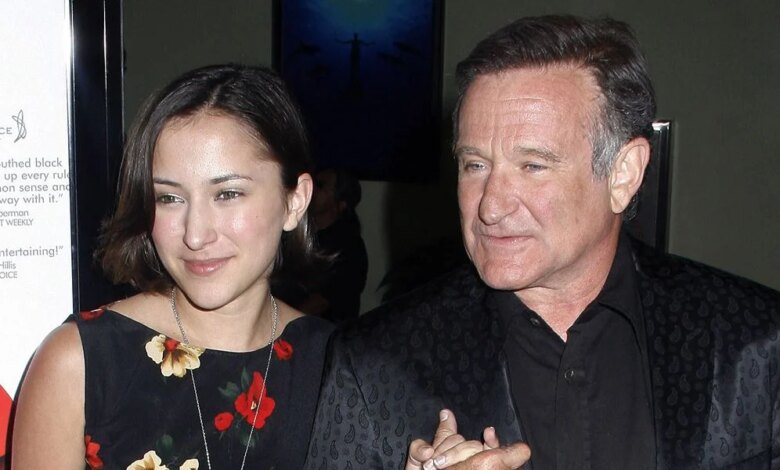
Zelda Williams is once again speaking out against AI videos featuring her late father, comedian Robin Williams, who passed away in 2014. The actress and filmmaker has criticized the use of artificial intelligence in the past, and she is making her feeling clear again. Her latest response comes from a deeply personal place, as she continues to push back against deep fakes of her father.
Zelda Williams Slams ‘Terrible’ AI Video Of Robin Williams
3KH1/WENN/Newscom/The Mega Agency
Robin Williams’ daughter, Zelda, took to social media after seeing a fake video of his father discussing conspiracy theories. The clip was falsely presented as a “private video” or “rare private footage” of the late actor that had supposedly been leaked.

Zelda clapped back, saying it was obviously AI-generated due to the “robotic and terrible” voice. The filmmaker addressed the creator of the video, writing, “leave him out of your delusional bullsh-t and let him rest. If you cannot make your case without making a dead man make it more convincing for you, then tell me: who’s the one manipulating the public thru media now?”
Zelda said she hates having to debunk AI slop but strongly feels the need to protect her father’s legacy. “I love him, so I will,” she wrote.
The Actress Reiterates Her Stance On AI
3Instagram Stories | Zelda Williams
On an Instagram Stories post, Zelda underscored her position on artificial intelligence, writing she “abhor[s] AI in every form.”
She also raised concerns about the ethical side of replicating people using AI, writing, “if you use these ‘tools’ to recreate real people and make them do whatever you’d like, you are very much removing their consent from the equation.”
Speaking about recreations of people without their consent, Zelda noted that deep fake creators are “denying another person of their autonomy” for the sake of spectacle.
Zelda Williams First Spoke Against AI In 2023
3Tammie Arroyo / AFF-USA.com / MEGA
In 2023, SAG-AFTRA went on strike over a labor dispute, including protections against artificial intelligence.
Amid the controversy, Zelda voiced her concerns on Instagram Stories, saying she was “not an impartial voice” in the fight against AI.
“I’ve witnessed for YEARS how many people want to train these models to create/recreate actors who cannot consent, like Dad,” she wrote. The filmmaker added that her concerns extend beyond her personal feelings about the matter.
William’s died by suicide on August 11, 2014 at 63 years old. The comedian struggled with health issues, which was later diagnosed as Lewy body dementia. His final Instagram post was a black-and-white photo with a young Zelda, shared on July 31, 2014, to celebrate his daughter’s birthday.
In August, Zelda, along with her siblings Zak and Cody, announced that they would be reviving their father’s Instagram account to share posts focusing on Robin’s comedic talent and humor.
“As technology evolves, we want this to be a safe, trusted place where the stories, photos, videos, and memories shared reflect his legacy with authenticity, warmth, and care,” the siblings wrote.
So far, the account has shared two new posts. The first one was a 1979 portrait of the comedian for TIME, and the second, a short clip of Williams as his alien character Mork from the sitcom “Mork & Mindy.”
The NO FAKES Act Bill Aims To Protect Against AI-Generated Replicas
Sean Astin, the President of SAG-AFTRA, recently testified before a U.S. House Judiciary subcommittee in support of the bipartisan NO FAKES Act.The proposed law would protect everyone, not just celebrities, from unauthorised AI-generated replicas of their voice and likeness. pic.twitter.com/GnQmTOTY4D— Tolkien World (@TolkienWorldG) July 2, 2026
The NO FAKES (Nurture Originals, Foster Art, Keep Entertainment Safe) Act is a proposed legislation designed to protect the voice of individuals, both private citizens and public figures, from unauthorized replicas generated by AI.
The proposed bill also covers post-mortem protection, allowing heirs or executors of estates to represent a deceased person.
Despite its purpose of protecting individuals against unauthorized use of their image and likeness, some have raised concerns that the proposed law could also restrict commentary and satire.
Source link