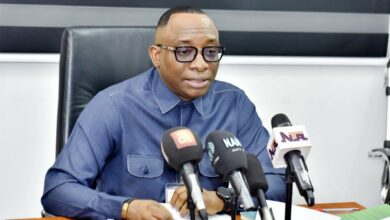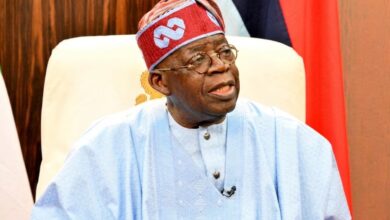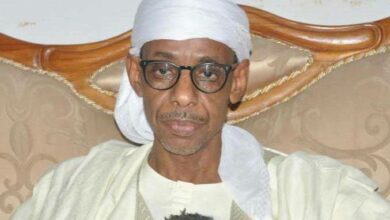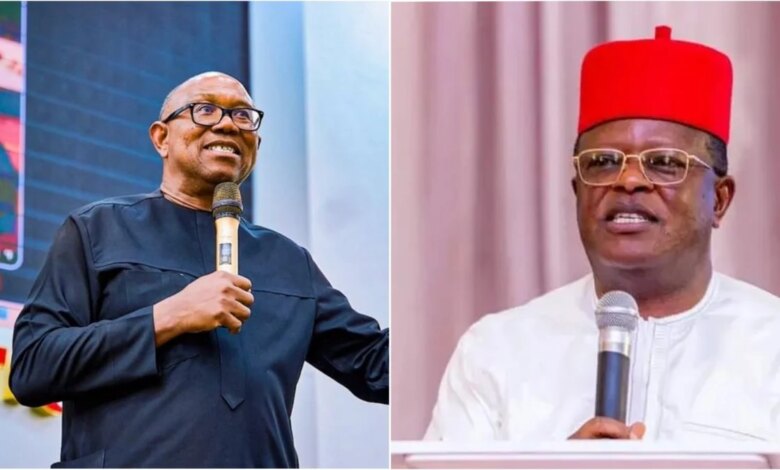
The Minister of Works, David Umahi, has dismissed Peter Obi’s chances of posing a serious challenge to President Bola Tinubu in the 2027 presidential election.
Umahi made the remarks during an interview with ARISE News on Friday, where he argued that Obi was not the best presidential candidate the South-East could produce and that other political leaders from the region were equally qualified to seek the presidency.
“Nobody is afraid of Peter Obi, he is no threat to Tinubu,” the minister said.
Umahi also criticised the Nigeria Democratic Congress (NDC) presidential candidate for allegedly failing to consult political leaders in the South-East before pursuing his presidential ambition in the 2023 election.


“Peter Obi is not the best of our finest in South East. He’s not the best, he can never be the best,” he said.
The former Ebonyi State governor argued that presidential aspirants seeking to represent the region should consult governors and other influential political stakeholders before declaring their ambitions.
“You cannot play politics in South East without consulting people like us,” Umahi said, adding that he would have consulted regional leaders if he had sought the presidency.
He maintained that Obi’s performance in the 2023 election should not automatically make him the South-East’s preferred presidential candidate, insisting that the region had other politicians capable of contesting the position.
Umahi also challenged the suggestion that Anambra State should automatically be favoured to produce a president from the South-East, noting that the region comprises five states.
He identified Ebonyi, Enugu, Abia, Imo and Anambra as states that should be considered in discussions about the region’s presidential prospects.
The minister defended South-East politicians supporting Tinubu ahead of the 2027 election, rejecting suggestions that their political choices amounted to a betrayal of the region.
According to Umahi, the South-East can improve its chances of producing a president through political negotiations and alliances with other regions rather than treating support for a particular candidate as a test of regional loyalty.
The minister also defended the cost of the Lagos-Calabar Coastal Highway, putting the price of a standard kilometre at N7.5 billion.
Umahi said Section One of the project, covering 47.47 kilometres, costs N1.067 trillion.
He explained that the N7.5 billion estimate was calculated by dividing the cost of the six-lane highway to arrive at the equivalent cost of a standard two-lane federal highway.
“A standard coastal road is going for N7.5 billion per kilometre of standard highway. However, this N7.5 billion includes all the fillings, shore protections, solar lighting throughout, and planting of trees,” he said.
According to the minister, the cost reflects the highway’s specialised construction requirements, including concrete pavement, shoreline protection, retaining walls, solar lighting, flyovers, underpasses and extensive sand filling.
He said some sections require sand filling to depths of up to 20 metres because of the terrain.
“This is an investment that the President is doing, and this is a road that is going to last for another hundred years,” Umahi said.
His explanation comes amid criticism over the project’s rising cost. In April 2024, he reportedly put the cost at N4 billion per kilometre, a figure that has since increased to N7.5 billion.
Umahi maintained that the coastal highway should not be compared with conventional roads because of its terrain and additional infrastructure requirements.
He also said motorists would be able to travel from Ahmadu Bello Way in Lagos through Sections One, Two and part of Section Four into Ondo State by November.
Umahi further warned that the Lagos-Calabar Coastal Highway could be abandoned if Tinubu fails to secure a second term in the 2027 presidential election.
The minister described the 750-kilometre project as a personal initiative of the president, arguing that continuity in government was necessary to ensure its completion.
“If President Tinubu does not come back in 2027 (God forbid), the Lagos-Calabar Coastal Highway will be gone,” he said.
Umahi, however, insisted that the project remained on course and could not be altered.
“The 750-kilometre coastal highway is intact and cannot be changed, and nobody has the powers to change it, because it’s already designed and it’s ongoing,” he added.
The minister also dismissed reports that the coastal highway had been abandoned in favour of the East-West Road.
He explained that Tinubu had approved the reconstruction of an additional 400 kilometres of the East-West Road, stretching from Edo State to Cross River State, alongside the coastal highway.
According to Umahi, the president directed that the coastal highway should follow the existing East-West Road corridor rather than create new alignments.
He attributed the adjustment to difficult construction conditions in Ondo State, where he said some construction pits were more than 100 metres deep and suitable sharp sand was unavailable within a distance of 300 metres.