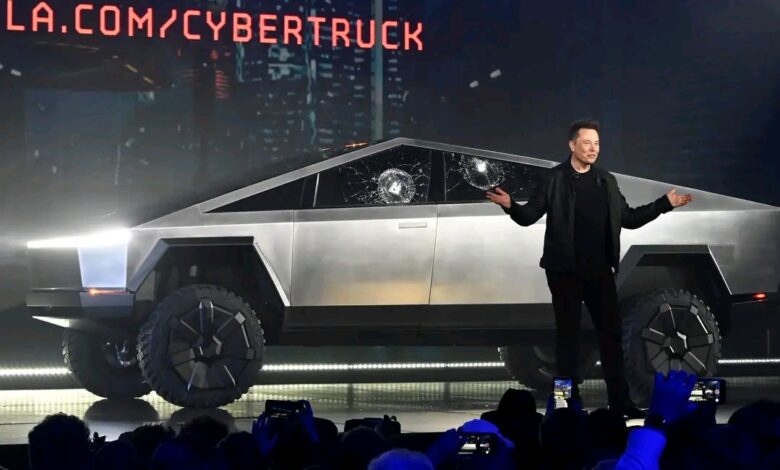
Tesla plans to wind down Cybertruck production at its Texas factory by mid-2027, marking a major retreat from Elon Musk’s ambitious electric pickup project as the company redirects manufacturing capacity towards its driverless vehicle business.
Chief Executive Officer Elon Musk announced the decision on Friday, 6 November, in a post on X, explaining that the adjustment would create room for increased production of the Cybercab, Tesla’s proposed autonomous taxi.
The announcement raises fresh questions about the commercial future of the Cybertruck, which entered the market in 2023 after years of promotion as a revolutionary challenger to established American pickup manufacturers.
Musk did not clarify whether production would move to another facility or end altogether. Tesla’s Austin Gigafactory is currently the only known manufacturing site equipped to produce the pickup’s specialised components, making the planned reduction particularly significant.


Responding to a user on X, Musk described the Cybertruck as the best vehicle Tesla had produced and called the production wind-down “the end of an era”.
He indicated that existing vehicles would continue operating for years, suggesting that the decision would not immediately affect current owners.
RELATED NEWS:
A costly ambition meets market reality
Unveiled in 2019, the Cybertruck generated considerable attention with its angular design and stainless-steel exterior. However, its unconventional appearance divided consumers, while recalls, quality-control concerns and repeated price adjustments complicated its commercial prospects.
Tesla does not publish separate Cybertruck sales figures. Instead, it groups the pickup with the Model S, Model X, Semi and Cybercab under its ‘Other Models’ category.
That segment recorded 8,295 deliveries in the third quarter of 2026, down from 12,364 in the preceding quarter. The figures offer an indication of weaker deliveries across the group, but they do not establish how many Cybertrucks were sold or how much the pickup contributed to the decline.
Its prospects outside the United States have also been constrained by regulatory difficulties, particularly in Europe, where its distinctive construction has raised safety and approval questions.
Tesla shifts towards driverless transport
The production adjustment reflects Musk’s growing emphasis on artificial intelligence, robotics and autonomous transportation.
The Cybercab, designed without a steering wheel, pedals or conventional mirrors, is central to Tesla’s ambition to establish a robotaxi network. The company began offering paid rides to members of the public using a limited fleet in Austin in September, following years of delays to its self-driving programme.
However, regulatory questions persist. The US National Highway Traffic Safety Administration has sought clarification on whether Tesla properly demonstrated compliance with federal vehicle safety standards through its self-certification process.
Cybertruck lead engineer Wes Morrill defended the pickup’s contribution to the company’s development, calling it an “incredible technology development platform”. He said its innovations would continue through the Cybercab.
The planned wind-down therefore represents more than a manufacturing adjustment. It signals Tesla’s willingness to move resources away from a high-profile vehicle towards a business model built around autonomous mobility.
Whether that bet delivers stronger commercial returns remains uncertain. The Cybertruck’s retreat also leaves an important question unanswered: will Tesla eventually revive the pickup elsewhere, or is this the beginning of its exit from the electric truck market?
For More News Updates, Visit New Daily Prime News