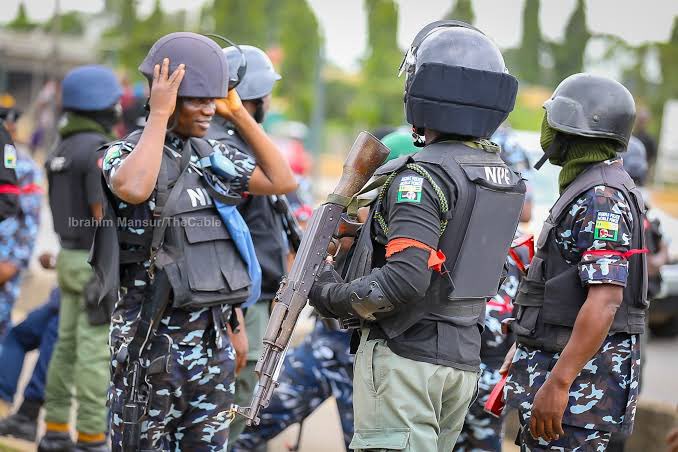
Nigeria is moving closer to a major change in its security system as the National Assembly prepares to send the State Police (Constitution Alteration) Bill, 2026, to President Bola Tinubu for approval, potentially by Friday, 20 November.
The proposed legislation would allow states to establish their own police services, ending the existing constitutional arrangement under which policing is primarily controlled by the Federal Government.
The development comes amid growing concerns about kidnapping, banditry, terrorism, communal violence and other crimes that have exposed weaknesses in Nigeria’s security system.
According to a report published by The Punch on Monday, 16 November 2026, at least 32 of Nigeria’s 36 state Houses of Assembly have approved the constitutional amendment, exceeding the 24 states required under Section 9(2) of the 1999 Constitution.


Parliamentary sources suggested that the number of approvals could have increased to 34, although that higher figure had not been formally confirmed in the report.
The development raises important questions about how state police would operate, who would control officers, how they would be funded and what safeguards would prevent politicians from abusing the system.
Here are 10 important things Nigerians should know.
1. What exactly is the state police bill?
The State Police Bill seeks to amend Nigeria’s 1999 Constitution to establish a policing system comprising federal and state police services.
Under the published constitutional amendment proposal, the Federal Police Service would continue handling national security responsibilities, while state police services would deal primarily with security issues within their respective states.
The proposal would therefore create two levels of policing, each with defined responsibilities, rather than completely replacing the existing national police institution.
2. Will all 36 states have their own police forces?
The proposed constitutional framework provides for state police services across the federation, but individual states would need to meet legal and operational requirements before their services could begin policing.
Each state would have to enact its own enabling legislation and obtain certification that its police service meets national minimum standards.
This means presidential assent would not automatically put 36 new police forces on the streets.
States would still need to recruit and train officers, provide equipment, establish oversight arrangements and demonstrate operational readiness.
3. Who will control state police — governors or the Federal Government?
The proposed amendment would give state governors an important role in policing, but not unlimited authority.
Under the published bill, the governor would appoint the state’s Commander of Police following a recommendation by the National Police Council and confirmation by the state House of Assembly.
Governors could also issue lawful written directions on general policing policy.
However, the proposal prohibits directions requiring officers to unlawfully arrest individuals, intimidate political opponents, suppress lawful political activities or violate fundamental rights.
State Police Service Commissions would also have responsibilities covering recruitment, promotion and discipline.
The key question is whether these legal safeguards would be effective in practice, particularly where governors exercise substantial political influence over state institutions.
4. What will happen to the Nigeria Police Force?
The existing Nigeria Police Force would not simply disappear.
The proposal provides for its continuation as the Federal Police Service, with existing officers remaining in service under transitional arrangements.
Federal officers would continue to handle matters involving terrorism, organised crime, border security, cybercrime, interstate offences and other federal responsibilities.
They would also continue policing states until their respective state services are authorised to begin operations.
The Federal Government would therefore retain significant policing powers nationwide.
5. Can state police officers arrest people?
Yes, the proposed system would permit properly established state police services to exercise police powers within their legal jurisdiction.
Their duties would include preventing crime, investigating offences, protecting lives and property, enforcing state laws and maintaining public order.
However, their authority would be subject to national legislation, constitutional rights and applicable standards.
The published amendment also provides that state police services generally cannot exercise police powers outside their states unless authorised by federal legislation.
These jurisdictional limits would be important in dealing with criminals who operate across state boundaries.
6. How will state police be funded?
Funding remains one of the biggest questions surrounding the proposal.
Under the published amendment, state Houses of Assembly would have powers to legislate for the establishment, administration, funding and oversight of their police services.
However, establishing a functional police service would require significant expenditure on salaries, recruitment, training, vehicles, communication equipment, technology, infrastructure and supervision.
Wealthier states might find it easier to establish adequately equipped police services than states already struggling to pay workers or maintain public services.
This creates an important economic question: Could state police widen the security gap between richer and poorer states?
The proposed national policing framework provides for federal legislation on grants, but the amount of financial support available to individual states has not been established in the material reviewed.
7. Can the Federal Government take control of state police?
Yes, but only under specified exceptional circumstances in the published constitutional amendment.
The proposal permits temporary federal intervention where a state police service cannot contain a serious breakdown of public order, is unable to function, or is implicated in serious abuses.
It also provides for intervention where state policing activities threaten national security or where a governor requests federal assistance.
Such intervention would require written presidential authorisation, notification to designated authorities and compliance with legal limits.
The bill also makes the legality and scope of intervention subject to judicial review.
These provisions are intended to balance state autonomy with federal responsibility for national security.
8. Could governors use state police against political opponents?
This is one of the most controversial questions surrounding the proposed reform.
Critics have raised concerns that governors could use state police officers to intimidate opposition politicians, influence elections, suppress protests or target political rivals.
These concerns are particularly relevant in states where political institutions may struggle to exercise independent oversight.
The proposed constitutional safeguards prohibit policing directions involving unlawful political intimidation and violations of fundamental rights.
It also provides for State Police Service Commissions and national standards covering accountability, complaints, discipline and use of force.
Nevertheless, the existence of legal safeguards does not automatically guarantee their enforcement.
Independent oversight, transparent appointments, accessible complaints procedures and judicial accountability would be necessary to protect citizens against abuse.
9. Will state police end kidnapping, banditry and terrorism?
State police could improve local intelligence gathering and response times because officers would operate closer to the communities they serve.
Officers familiar with local languages, geography and security threats might be better positioned to identify criminal networks and respond to emergencies.
However, state police would not automatically eliminate insecurity.
Criminal groups frequently operate across state boundaries, meaning federal and state security agencies would need effective systems for exchanging intelligence and coordinating operations.
Without adequate funding, professional training and independent oversight, the creation of additional police institutions could introduce new challenges instead of resolving existing ones.
The success of the reform would therefore depend on implementation rather than constitutional recognition alone.
10. Has the state police bill become law, and what happens next?
As of 16 November 2026, the proposed constitutional amendment had secured more than the required two-thirds approval from state Houses of Assembly, according to the National Assembly’s official account.
Senate Leader Opeyemi Bamidele said 32 states had approved the proposal, while parliamentary sources suggested that as many as 34 might have done so.
The Punch report identified Cross River and Niger as the two states whose approval remained outstanding, based on its findings.
The Senate Leader indicated that remaining state assemblies could have until Tuesday, 17 November, to submit their reports.
The next major step is presidential assent, although reports differ about whether formal transmission has already occurred. The Guardian reported on 5 November that Deputy Speaker Benjamin Kalu said the bill had been transmitted, while the latest Punch report says transmission may take place by Friday.
Even after presidential assent, further legislation and administrative measures would be necessary to establish an operational state policing system.
The Presidential Working Group on the National Policing Bill has also submitted a draft National Policing Bill, 2026, alongside 29 consequential amendment bills to the Ministry of Justice for review.
These measures are intended to provide a more detailed legal framework for implementing policing reforms.
What Nigerians should know
The State Police Bill represents a potentially significant change in how Nigeria manages internal security.
For Nigerians living abroad who have relatives, businesses, property or investments at home, its practical importance will depend on whether it produces safer communities and more accountable policing.
The proposed reform also raises financial and constitutional questions about state autonomy, the division of security responsibilities and the protection of civil liberties.
The central issue is no longer simply whether states should have their own police services. It is whether Nigeria can establish an effective system that protects citizens without allowing those in political office to misuse policing powers.
Until the constitutional amendment receives the necessary assent and the supporting framework is implemented, the proposed changes should not be presented as an operational state police system.
Read related news:
Nigeria’s state police could create 554,353 jobs, says Abiodun
State Police: Plateau backs reform as Nigeria’s 36 assemblies face test
Tinubu political remark dominates ADC peace appeal