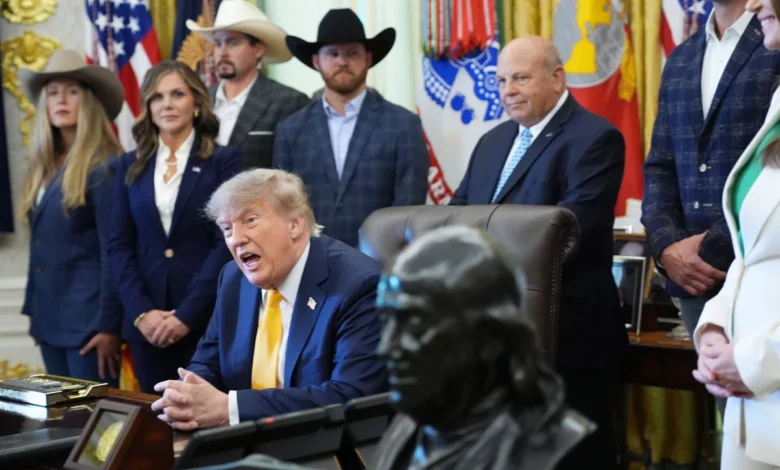
The administration of United States President Donald Trump has announced more than $15 billion in financial assistance and agricultural initiatives for American farmers, just days before the November 3 midterm elections.
The measures are intended to ease mounting financial pressures on agricultural producers struggling with rising diesel and fertiliser costs, which have been compounded by trade uncertainties and the economic consequences of the US war with Iran.
The package includes an $8 billion one-time payment programme to help farmers cope with rising diesel expenses, alongside at least $5 billion in guaranteed loans for ranchers and fishermen.
The announcements come as the Republican administration faces growing economic concerns among rural communities, traditionally an important voting base for the party.

BREAKDOWN OF THE $15 BILLION ASSISTANCE
More than half of the announced support will go towards the $8 billion diesel-relief programme, designed to compensate farmers for a portion of their increased operating expenses.
The US Department of Agriculture (USDA) is expected to provide further details about the payment arrangements this month, although the precise date farmers will receive the money remains unclear.
Other initiatives include $1.8 billion for producers and landowners participating in conservation programmes, $573 million for fertiliser manufacturing projects and $57 million to expand meat-processing facilities.
The administration has also allocated $86.6 million in grants for projects supporting specialty-crop producers.
Separately, the USDA plans to distribute $13.8 billion through existing agricultural safety-net programmes to eligible farmers affected by losses during the 2025 crop year.
The agency also announced plans to purchase up to $472.5 million worth of agricultural commodities to support producers and supply charitable programmes.
RISING COSTS PUT PRESSURE ON FARMERS
American agricultural producers have faced increasing operational expenses, particularly for fuel and fertiliser, making it more difficult for some farming businesses to remain profitable.
Diesel prices averaged $6.32 per gallon on Friday, approximately 70 per cent higher than the same period last year, according to figures from the American Automobile Association (AAA).
The increase has significantly affected farmers who depend on diesel-powered tractors, trucks and harvesting equipment.
Gregg Ibendahl, a farm management specialist at Kansas State University, said uncertainty surrounding agricultural input costs and global developments had placed additional pressure on farmers.
“That input side risk, I think, is the thing that really has hurt farmers this year, as well as the fact that there has been a lot more uncertainty about what’s going to happen in the world,” Ibendahl said.
He also expressed concerns about the long-term implications of relying on temporary government assistance, particularly when farmers seek financing for subsequent planting seasons.
“It’s hard to go to your lender in the next spring and say, ‘OK, well, we’re looking pretty good this year, but it’s all because of these extra temporary government payments, so how much can you make me a loan (for) next year for my crop?’” he said.
His comments highlight concerns that while government assistance may provide immediate financial relief, it may not resolve the underlying challenges affecting the profitability and long-term financial stability of American farmers.
MIDTERM ELECTIONS RAISE POLITICAL QUESTIONS
The timing of the announcements has also drawn attention because they come just days before Americans head to the polls on November 3 to elect members of Congress.
President Trump is scheduled to visit Iowa and Kansas ahead of the elections, two agricultural states where some traditionally Republican-held seats are facing competitive contests.
Rural communities have historically provided significant electoral support for Republicans, but rising production costs and uncertainty surrounding agricultural markets have created concerns among some farmers.
Michael Smith, a political science professor at Emporia State University, said support for Trump personally does not necessarily translate into approval of his administration’s policies.
“Some people who admire Trump really just admire the person, the man,” he said. “But it doesn’t mean they necessarily like his policies. Well, Trump himself isn’t on the ballot this year. His policies are.”
Meanwhile, Alexandra Middlewood, an associate professor of political science at Wichita State University, highlighted the potential influence of independent voters in the upcoming elections.
“Independent voters make or break elections,” she said. “And so that’s really what it’s going to come down to this year is those independent voters and who they’re breaking for.”
Her comments point to the importance of independent voters as candidates seek support beyond their traditional political bases.
With the November 3 elections approaching, it remains uncertain whether the latest financial commitments will influence voter participation or address wider dissatisfaction among agricultural producers.