Interview: UN maritime agency hopes to evacuate most vessels stranded in Strait of Hormuz within weeks

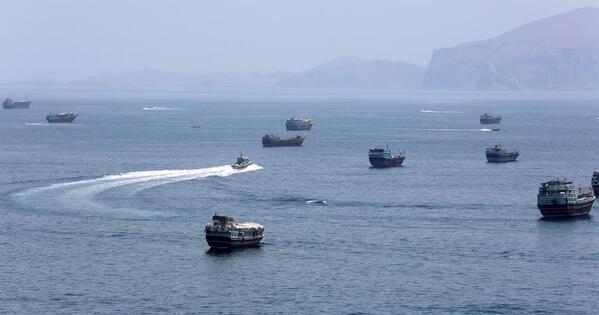
The vessels are being grouped into batches according to their evacuation needs, how long they have been stranded, and their location in the Persian Gulf, and are instructed to proceed to designated holding areas before receiving permission to transit the strait, according to IMO Secretary-General Arsenio Dominguez.
by Xinhua writer Gao Wencheng
LONDON, June 25 (Xinhua) — The International Maritime Organization (IMO) hopes to evacuate the majority of vessels stranded in and around the Strait of Hormuz within the next few weeks under a newly launched evacuation framework, IMO Secretary-General Arsenio Dominguez said Wednesday.
The UN maritime agency announced the evacuation plan on Tuesday for seafarers stranded in the Strait of Hormuz and surrounding waters.

The operation, coordinated with regional countries and industry stakeholders, is expected to facilitate the safe departure of around 11,000 seafarers aboard some 600 vessels affected by the ongoing crisis, Dominguez told Xinhua in an interview.
“We’re working on a day-by-day basis to increase the number of transits, and hopefully in the next few weeks we will be able to have evacuated the majority of the vessels,” he said.
The Strait of Hormuz, which links the Persian Gulf with the Gulf of Oman, is one of the world’s most strategically important maritime chokepoints and a vital artery for global energy trade. At the peak of the recent crisis, more than 20,000 seafarers were stranded in surrounding waters, and attacks on merchant vessels left at least 14 seafarers dead.
The operation, he said, must proceed cautiously and in a phased manner, given the complex security situation.
“We’re taking this step by step,” Dominguez said. “This is a coordinated and organized approach.”
The current Traffic Separation Scheme (TSS) in the Strait of Hormuz, adopted by the IMO in 1968, cannot be used at present because of reports of mines in the area.
“It is clear right now that the current traffic separation scheme is not open or safe for operations,” he said. “Until that route is cleared, and we have confirmation that it’s safe, we are not able to use it.”
As an alternative, vessels are being guided through routes communicated by Iran on the northern side of the strait and by Oman on the southern side. A Notice to Mariners jointly issued by Oman and the IMO came into effect earlier this week, marking the start of the evacuation mechanism.
According to Dominguez, the vessels are being grouped into batches according to their evacuation needs, how long they have been stranded, and their location in the Persian Gulf, and are instructed to proceed to designated holding areas before receiving permission to transit the strait.
“The vessels will be contacted, they will be requested to move into position and then the Sultanate of Oman will coordinate the use of the route to avoid any collisions,” Dominguez said.
The IMO chief revealed that the organization had engaged in extensive consultations with all littoral states in the region, including Iran and Oman, as well as countries such as the United States, Britain and France.
“We actually received the safety guarantees that were required in order to establish these corridors,” he said.
Dominguez applauded ongoing diplomatic contacts between the United States and Iran, saying they could contribute not only to easing tensions but also to restoring normal transit through one of the world’s most important shipping lanes.
“Returning to transit in the Strait of Hormuz is for the benefit of everyone, not only the countries in the region,” he said.
As the world marks the Day of the Seafarer on June 25, the IMO has set this year’s theme as “Carrying world trade. Carrying the risks.”
Dominguez said the crisis has once again highlighted the hardships and vulnerabilities faced by seafarers caught in geopolitical conflicts.
“For IMO, people always come first,” he said. “This is not about the type of vessels or the cargo that they have on board, but the most important asset, which of course is the people.”
He described the past four months as “detrimental and very sad” for innocent seafarers trapped by the conflict, adding that the situation had taken a serious toll on mental health, causing fatigue and significant stress among those affected.
“My sentiments and condolences go directly to those seafarers that unfortunately have lost their lives because of this conflict and their families,” he said.
For Dominguez, one of the most striking lessons from the crisis is that seafarers around the world are increasingly bearing the consequences of geopolitical tensions, from the Red Sea to the Black Sea and now to the Strait of Hormuz.
“Shipping should not be used as collateral in any geopolitical conflict,” he noted.
Calling seafarers the backbone of global trade, the IMO chief urged the international community to give them greater recognition and support.
“They can be your brothers and sisters. They should be recognized as key workers because it’s thanks to them that we receive every single good that we use at home every day,” he said.
Dominguez said seafarers and issues concerning their training, safety and security have always remained at the top of the IMO’s agenda, even if they do not always receive the same public attention as other international issues.
“Shipping is successful, sustainable, efficient and secure thanks to seafarers. So it’s a big thank you for everything that they do for everyone around the world,” he said.