ECOWAS Urges Enforcement of Existing MSME Policies, Recommends Sanctions For Non-Compliant Member States

0
The ECOWAS Commission has called for stricter enforcement of policies designed to support Micro, Small and Medium-sized Enterprises (MSMEs), urging sanctions against member states that fail to implement agreements already adopted at the regional level.
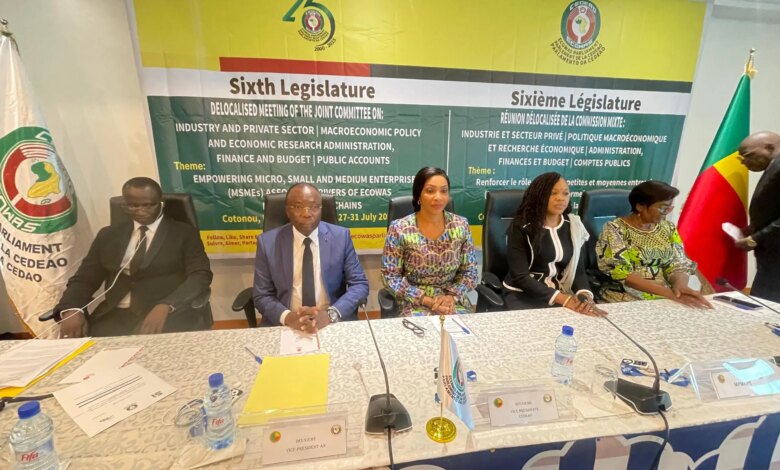
The recommendation was made on Monday during the ongoing delocalized meeting of the ECOWAS Parliament’s Joint Committee on Industry and Private Sector, Macroeconomic Policy and Economic Research, Administration, Finance and Budget, and Public Accounts in Cotonou, Republic of Benin.
Speaking on the theme, “Trade Facilitation, Regulatory Reforms and Formalisation,” Dr. Tony Luka Elumelu of the ECOWAS Business Council Secretariat said the region already has sufficient policies, protocols and legal frameworks to drive private sector development, stressing that the real challenge lies in implementation.

According to him, ECOWAS should prioritize creating an enabling business environment rather than introducing additional policies.
“We already have robust policies, protocols, legal instruments and the MSME Charter to support enterprise development. What is required now is to implement what has already been adopted, enforce existing regulations and eliminate bottlenecks preventing MSMEs from thriving,” he said.
Dr. Elumelu also emphasized that West Africa must position itself competitively under the African Continental Free Trade Area (AfCFTA), noting that excessive bureaucracy and obstacles to legitimate trade could undermine the region’s economic prospects.
He urged governments to invest in transport infrastructure that facilitates the movement of goods across borders while removing unnecessary barriers affecting businesses operating legally within the region.
The ECOWAS official further identified multiple checkpoints and roadblocks across member states as major obstacles to regional trade and economic integration.
He called for clear implementation timelines for ECOWAS legal instruments, arguing that policies approved by the regional parliament should be backed by effective monitoring mechanisms to ensure compliance.
Also speaking, the ECOWAS Commission’s Principal Programme Officer for Enterprise and Business Promotion, Dr. Olalekan Afolabi, advocated greater efforts to formalize businesses across the region.
He noted that a significant proportion of enterprises in West Africa still operate in the informal sector and urged ECOWAS parliamentarians to persuade national governments to adopt measures that encourage business formalization.
Dr. Afolabi also highlighted the importance of implementing the European Union-funded African Trade Competitiveness and Market Access Programme, a €50 million initiative aimed at strengthening trade and improving market access across Africa.
According to him, member states must domesticate and legislate regional policies at the national level while parliamentarians should actively monitor implementation and hold institutions accountable.
He described the ongoing parliamentary meeting as an important platform for strengthening oversight and ensuring that regional commitments translate into tangible economic benefits.
Participants at the session agreed that effective implementation of existing ECOWAS policies would significantly enhance MSME growth, promote regional trade and accelerate economic development across West Africa.