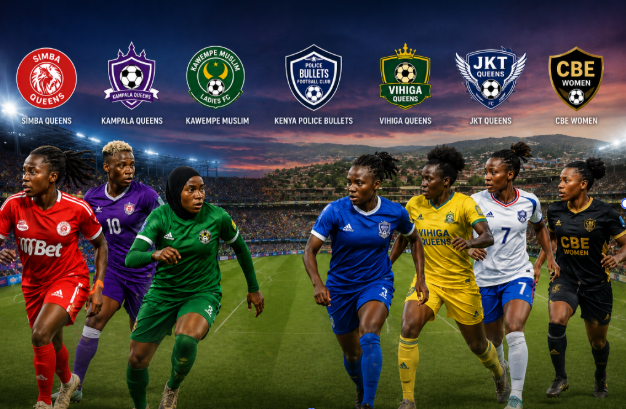
Alt: Seven women’s football clubs players.
Women’s club football in East Africa has entered a new phase. Domestic titles still matter, yet clubs now chase a bigger target. A place in the CAF Women’s Champions League can change a team’s profile, attract sponsors, and raise playing standards. Competition has become tougher, and several clubs have emerged as the region’s main trendsetters.
Growing interest in football entertainment has also expanded the audience around the women’s game. Many supporters follow club performances through football-focused services such as official 1xBet website, where football remains one of the most popular sports categories.
The region now boasts a group of clubs that set the pace for everyone else. Some dominate domestic competitions. Others focus on talent development and long-term planning. Together, they help push women’s football to a higher level.

Why club football matters more than ever
The launch of the CAF Women’s Champions League changed expectations. Winning a local league no longer represents the final destination. Clubs now view domestic success as a stepping stone toward continental competition.
This shift affects every part of football operations. Coaching staffs work with greater tactical detail. Recruitment departments search for experienced players. Club executives seek stronger commercial partnerships.
Several indicators highlight this progress:
- Higher investment in player development programs.
- Better training facilities and medical support.
- Greater media attention and fan engagement.
Simba Queens: setting the benchmark
Few clubs carry as much weight in regional conversations as Simba Queens. The team established itself as one of the strongest forces in East African women’s football and continues to compete for major honors.
Their success comes from consistency. Strong squad management and clear long-term planning have helped the club remain near the top.
Continental performances also strengthened the club’s reputation. Strong results against regional rivals demonstrated that domestic dominance can translate onto a bigger stage. That achievement placed Simba Queens firmly among the region’s elite.
Kampala Queens and Kawempe muslim keep raising standards
Uganda’s football scene features two clubs that command respect across the region. Kampala Queens and Kawempe Muslim have developed a rivalry that pushes both organizations forward.
Kampala Queens gained attention through strong league campaigns and impressive squad depth. The club combines experienced players with emerging talent. That balance helps maintain competitive performances throughout a long season.
Kawempe Muslim follows a slightly different path. The club built its reputation through player development and tactical discipline. Many observers view it as one of the most efficient football projects in the region.
The rivalry helps raise standards across the league and attracts greater attention to women’s football..
Kenya Police Bullets and Vihiga Queens lead a strong challenge
Kenya’s contribution to regional football deserves attention. Kenya Police Bullets and Vihiga Queens remain among the most recognizable names in the women’s game.
Kenya Police Bullets have become a symbol of ambition. The club invested heavily in building a squad capable of competing beyond domestic borders. Results suggest that strategy is paying off.
Vihiga Queens already possess a strong continental reputation. The club represented the region in major competitions and gained valuable experience against top opposition. Those appearances helped establish credibility beyond national boundaries.
JKT Queens and CBE Women add new energy
Strong competition depends on fresh challengers. JKT Queens and CBE Women provide exactly that.
JKT Queens continue to build momentum through disciplined performances and steady improvement. The club frequently challenges established powers and refuses to accept an outsider label. Every season brings higher expectations.
CBE Women have followed a similar trajectory. The team gained recognition through organized football and impressive consistency. Opponents know that points rarely come easily against them.
Their emergence increases competition and challenges established clubs.
What separates these seven clubs from the rest
The leading clubs share several common traits.
Key factors include:
- Long-term planning instead of short-term decisions.
- Investment in coaching, fitness, and medical support.
- A clear identity both on and off the pitch.
These clubs also invest in visibility through social media, community engagement, and media relations.
Growing public interest has strengthened the connection between women’s football and football entertainment platforms. Supporters increasingly follow club news and major competitions while exploring options such as a 1xBet bonus offer during important tournaments and league campaigns.
The continental dream driving every decision
CAF Women’s Champions League qualification remains the biggest motivation. Clubs measure progress through their ability to compete beyond domestic competitions.
Recent developments have highlighted the growing importance of continental qualification. CAF and regional football bodies continue preparations for the next cycle of CAF Women’s Champions League qualifying tournaments, with several qualification events already scheduled across different regions of Africa. The announcements have renewed attention on clubs seeking to earn a place in the continent’s premier women’s club competition.
The tournament offers international exposure, stronger opposition, and valuable experience for players.
Greater visibility has also increased interest from football betting audiences, with supporters paying closer attention to team form and performances in regional tournaments.
The challenge remains difficult. Competition grows stronger each year, and qualification spots remain limited. Still, ambition continues to drive investment across the region.
Modern clubs must balance sporting performance, commercial growth, and financial stability to achieve lasting success.
The result is a more competitive landscape where small decisions can influence an entire season.
A Region Moving Forward Together
Women’s football in East Africa no longer revolves around isolated success stories. The strongest clubs now form part of a broader movement that continues to reshape expectations.
Simba Queens, Kampala Queens, Kawempe Muslim, Kenya Police Bullets, Vihiga Queens, JKT Queens, and CBE Women each contribute something different.
Together, they create the foundation for future growth. Their performances and ambitions continue to raise standards across the region.
The next chapter will unfold on domestic pitches and continental stages alike. For now, these seven clubs remain the teams setting the pace and defining what success looks like in East African women’s football.