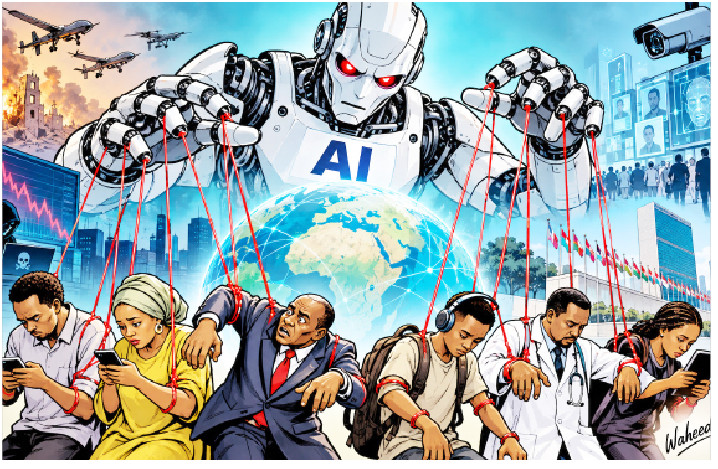
There is AI, and there is AI. The world uses the acronym to mean artificial intelligence. But it could mean other things too. Artificial Incompetence. Avoiding Inconvenience. Always Interested. Always Improving. Artificial insemination. Amazing Impact.
AI is only as good as how it is deployed. It can never (and may it never) be a replacement for the human experience.


Artificial Insemination
This is not the first time the world has had to contend with the troubling possibilities of an AI. Before artificial intelligence (AI), there was artificial insemination (AI), which was viewed as an existential threat to the sanctity of natural human reproduction. Both technologies provoked fascinating psychological and cultural parallels because they challenged deeply rooted definitions of human uniqueness and creation.
Just as critics of artificial insemination in the 19th and mid-20th centuries argued that it reduced the sacred act of procreation to a mechanical process devoid of the “soul” and biological intimacy of family creation, today’s anti-AI crusaders warn that artificial intelligence diminishes the sacred or unique aspects of art, writing, empathy, and problem-solving to mere statistics, pattern recognition, and mathematical weights. They argue that if a machine can replace human thought, human uniqueness is diminished.
Predictably, religious and conservative institutions vehemently opposed early artificial reproduction, often condemning it as “unnatural”, adulterous, or a dangerous usurpation of divine authority. Why, they asked, would man be playing God?
Some people expressed the fear that a child might be conceived without a husband’s knowledge or consent, shaking the foundational trust of the nuclear family and introducing profound anxieties about lineage, inheritance, and identity.
In the same vein, recent worries focus heavily on deepfakes, synthetic media, and algorithmic deception, where people can no longer trust whether an image, voice, text, or news report was created by a human or a machine. There are literally millions of examples of this on social media. In this political season in Nigeria, people will not know what to believe. It is not prophetic to say that deepfakes will be a standard fare of the electioneering menu.
Brave New World
Critics recall that artificial reproduction was the first step down a slippery slope toward state-engineered production of “designer babies” and the total commodification of human life (fears later amplified by the advent of IVF and cloning, which echoed Aldous Huxley’s book, Brave New World).
In the celebrated book, Huxley creates a dystopian classic set in a futuristic World State where society is engineered for maximum stability, consumerism, and artificial happiness. Children are no longer born naturally; instead, they are incubated from hatcheries and chemically conditioned into a rigid, five-tiered caste system ranging from the intellectual Alphas down to the manual-labour Epsilons.
To prevent any emotional turmoil, individuality, family, art, and religion have been eradicated. Citizens are kept docile through mandatory conditioning, casual promiscuity, and soma, a legal, mood-altering drug that provides instant escapism. Can you imagine a world where you need mkpuru mmiri (meth) to function effectively?
Similarly, AI warnings frequently invoke dystopian sci-fi tropes where autonomous systems eventually subjugate their creators. Could anything be more dangerous than a robot that out-thinks its creator?
Once you start, you can’t predict where or how it will end. Remember Adolf Hitler’s eugenics programme that was aimed at engineering a “racially pure” Aryan society through a state-sponsored law for the Prevention of Hereditarily Diseased Offspring (1933), which mandated the forced sterilisation of hundreds of thousands of individuals with physical, mental, or psychological disabilities? This campaign escalated into Aktion T4, a clandestine mass murder operation that systematically killed institutionalised disabled children and adults using lethal injections and gas chambers. Ultimately, these pseudoscientific racial hygiene principles provided the ideological blueprint for the Holocaust and industrial-scale genocide.
Papal Warning
In the current debate on artificial intelligence, Pope Leo XIV has made the governance, ethics, and societal impact of AI a major focal point.
In his first major encyclical, titled Magnifica Humanitas (“Magnificent Humanity”), released in May 2026, the pontiff establishes a strict moral baseline for the digital age, drawing parallels between the rapid disruptions of modern automation and those of the Industrial Revolution. He warns against the “insidious” technocratic mindset that measures a person’s worth solely by their productivity, efficiency, or economic output.