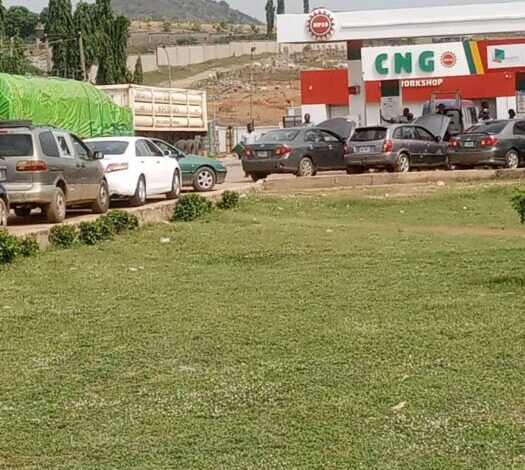
As the federal government intensifies its push to move Nigerians from petrol to Compressed Natural Gas (CNG), motorists in the Federal Capital Territory (FCT) are increasingly embracing the cheaper fuel alternative but are being forced to endure long queues, limited outlets and uncertain access to supplies.
Ahead of the October rollout of the next phase of the government’s CNG programme, checks at some CNG dispensing points across Abuja showed a growing gap between demand for the cheaper fuel and the infrastructure available to serve motorists.


At some stations, motorists spend several hours waiting to refill their vehicles, with some arriving as early as dawn and others reportedly sleeping in their vehicles overnight to secure a place in the queue.
For many users, the attraction is obvious: CNG costs considerably less than petrol and, in several cases, has substantially reduced their weekly transportation expenses.
At the Dei-Dei Mega Filling Station, one motorist, Okechuku Austin, said he had been waiting for several hours to refill his vehicle.
Austin, who has used CNG for about three months, said there was little doubt that the fuel was more economical than petrol, but argued that accessibility remained the biggest obstacle to its wider adoption.
“For me, I’ve been here since morning. It’s around 7:30 to 8 and it’s now after one. So getting the CNG itself is a problem. That is the major problem with it,” he said.
According to him, the long queues are particularly difficult for motorists who use their vehicles for work and cannot afford to spend most of the day waiting at a filling station.
He observed that commercial drivers appeared more willing to tolerate the delays because the savings from CNG significantly affect their operating costs.
“Most of the people on the queue using CNG are in the transport sector. Many of them feel safer and cheaper, so they wouldn’t mind spending long hours. Some even park their cars. Some sleep overnight,” Austin said.
“But for somebody that is going to work, you can’t tell your boss that you want to go and queue for CNG the whole day.”
He called for the establishment of more CNG dispensing points across the FCT, saying motorists should be able to access the fuel with the same ease with which they buy petrol.
“Government should be thinking of how to make it readily available. It can be available in many filling stations so that people can access it easily, just the way you access fuel,” he said.
Austin, however, said he was uncertain about reports concerning the long-term effect of CNG on vehicle engines, describing the fuel as relatively new to many Nigerian motorists.
“As for the engine part, I don’t know, because we have not been getting any. It’s still a new product. We have to test and see how it affects,” he said.
Despite the concern, he maintained that CNG remained a good alternative to petrol if government and private investors could resolve the accessibility problem.
At the Ushafa-Bwari NNPC filling station, another user, Obera Victor, described the experience of obtaining CNG as “not easy,” blaming the situation on inadequate availability.
“Time will come to buy CNG. You have to queue for a very long time before you get the CNG. So the experience is not easy at all,” Victor said.
However, he said the lower cost and better mileage had made him remain committed to CNG.
“I prefer using CNG because the price for CNG is less compared to that of fuel. And it’s like it lasts longer than fuel,” he said.