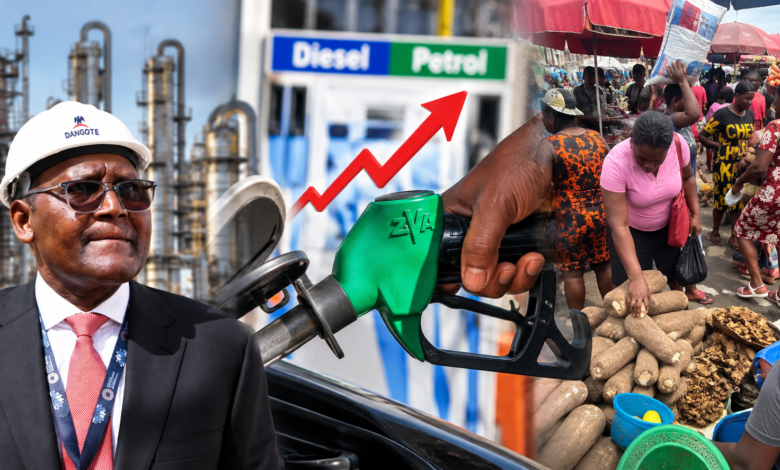
Nigerians face renewed pressure from rising fuel costs after Dangote Petroleum Refinery increased its petrol gantry price to ₦1,350 per litre, while diesel prices have climbed above ₦2,000 in parts of the country. The increase took effect on Saturday, 12 September 2026, and could feed through to transport, food and business costs if marketers pass higher wholesale prices on to consumers.
Motorists should, however, note that the ₦1,350 figure is the refinery’s gantry price — the price paid by marketers loading petrol from the refinery — rather than a fixed retail price at filling stations.
Actual pump prices can differ from one location to another because marketers must also account for transportation, distribution and other operating costs.
Dangote raised its Premium Motor Spirit, commonly known as petrol, from ₦1,265 to ₦1,350 per litre, an increase of ₦85 or about 6.7 per cent. It is the refinery’s fourth upward adjustment since 21 August.

The refinery’s gantry price has now risen by ₦185 per litre in about three weeks, from ₦1,165 on 21 August to the latest ₦1,350 level.
A circular sent to customers said the revised prices were “effective from 12th September 2026”.
Customers with existing loading documents were also told to return them for repricing before loading could resume.
Diesel prices add to pressure on businesses
The petrol increase comes as diesel prices are also putting pressure on manufacturers, transport operators and businesses that depend on generators.
According to Vanguard, Diesel was selling at about ₦2,100 per litre in Lagos and Ogun earlier in September, compared with roughly ₦1,700 to ₦1,800 only days before, according to reports citing manufacturers.
Separate market data showed diesel at around ₦1,950 per litre at some Lagos depots, while prices reached ₦2,100 at one Port Harcourt depot.
The difference illustrates why consumers should not assume there is one national fuel price. Nigeria operates a deregulated downstream petroleum market, meaning retail prices can vary according to supply costs, location, transport expenses and the margins charged by individual marketers.
The effect can be greater in inland areas because petroleum products have to travel longer distances from refineries and coastal depots.
Global oil prices drive up costs
The latest increases come against the backdrop of higher international crude prices and concerns over global oil supplies.
Brent crude moved above $100 a barrel during the recent market disruption, increasing the cost pressure faced by refiners and companies replacing fuel stocks.
That matters in Nigeria even though the country produces crude oil and now has substantial domestic refining capacity.
Refineries still operate in a market where the value of crude oil, the naira-dollar exchange rate, shipping costs and other expenses can influence how much finished petroleum products cost.
If crude prices remain high or the naira weakens, marketers could face higher replacement costs when buying new supplies.
Higher fuel costs could reach food and transport prices
The concern for households goes beyond the amount motorists pay to fill their vehicles.
Petrol and diesel are major costs for transport firms, farmers, manufacturers, retailers and small businesses. Higher fuel costs can therefore feed into the price of moving food, operating machinery, running generators and transporting workers.
Nigeria is already dealing with significant inflation. The National Bureau of Statistics currently lists headline inflation at 15.43 per cent and food inflation at 20.31 per cent.
That means another sustained increase in energy and transport costs could further squeeze household budgets.
Manufacturers have also warned about the effect of expensive diesel on production. The Manufacturers Association of Nigeria said power-related expenses had risen to more than half of operating costs for some manufacturers as diesel prices climbed.
This could leave businesses with difficult choices: absorb the additional expense, reduce production or pass some of the cost to customers.
Readers can also follow Nigeria’s economy and energy coverage through NewDailyPrime.news
Related news
What readers should know
The most important point is that ₦1,350 is Dangote Refinery’s wholesale gantry price and not an automatic nationwide pump price. Filling-station prices will depend on each marketer’s supply, transport and operating costs. But with petrol wholesale prices rising and diesel already above ₦2,000 in some markets, households and businesses could face higher transport and operating expenses if the increases persist.