BY NSE ANTHONY-UKO, BUKOLA ARO-LAMBO, OLUSHOLA BELLO, KINGSLEY OKOH AND DEBORAH BELLO
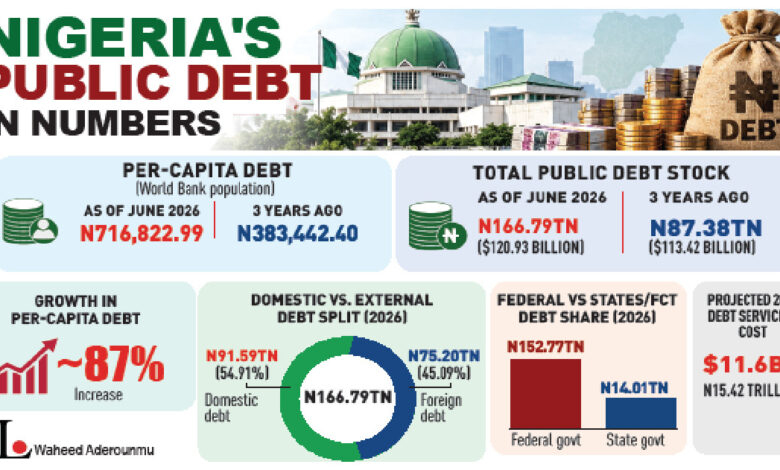
Nigeria’s public debt burden has again sparked public and economic concern after fresh calculations showed that every Nigerian now carries an estimated N716,822 in public debt, up from N383,442 three years ago — an increase of about 87 per cent.


This individual debt figure is based on the latest figures from the Debt Management Office (DMO) divided by the World Bank’s population estimates for both periods.
The rise is even more stark when measured against what Nigerians actually earn, with debt per person now accounting for a far larger share of average income than it did three years ago.
The disclosure has renewed debate about debt sustainability, with economists warning that the pace of borrowing is outstripping the country’s capacity to service its debt. Debt-servicing costs have become a growing concern, with Nigeria projected to spend more than $11.6 billion on debt servicing in 2026 — up sharply from the previous year — even as recurrent government spending continues to rise.
LEADERSHIP’s checks showed that three years ago, at the end of June 2023 — the first debt figure published after President Bola Tinubu assumed office — Nigeria’s total public debt stock stood at N87.38 trillion.
Divided by the World Bank’s population estimate for that year, 227,882,945, the per-capita debt burden worked out to roughly N383,442 at the time.
Today, with the debt stock at N166.79 trillion as of June 30, 2026, and the population estimated at 232,679,478, per-capita debt has surged to N716,822 — an increase of N333,380 per person, or about 87 per cent, in three years.
The debt stock itself nearly doubled in naira terms, rising by N79.41 trillion, or 90.9 per cent, over the same period.
The per-capita figure shifts depending on the population estimate applied. Using the National Population Commission’s (NPC) own projection of slightly more than 216 million — last updated by NPC Chairman Nasir Isa Kwarra — the current per-capita debt burden rises to roughly N772,175.
Analysts have, however, noted that part of the naira-denominated surge reflects currency depreciation rather than new borrowing alone.
Recall that in June 2023, shortly after the naira was floated under the new administration, the official exchange rate closed the month at N769.25/$1 at the I&E window. By comparison, the official NFEM rate as of September 2026 stood at about N1,329/$1 — a depreciation of about 72.8 per cent over the three-year period.
That currency slide means Nigeria’s dollar-denominated debt grew far more moderately than the naira figures suggest: from about $113.6 billion in June 2023 to $120.93 billion in June 2026, an increase of only about 6.4 per cent.
Debt Burden Outpacing Income
A more troubling picture emerges when per-capita debt is weighed against per-capita income.
According to World Bank data, Nigeria’s GDP per capita stood at roughly $1,596.6 in 2023. At the June 2023 exchange rate of N769.25/$1, this translated to approximately N1,228,378 per person. That put per-capita public debt of N383,442 at about 31 per cent of per-capita income at the time.
By 2024 — the most recent year for which World Bank figures are available — Nigeria’s GDP per capita had fallen to $806.9, a drop of more than 49 per cent, driven largely by the naira’s devaluation and the rebasing of the economy. Converted at the current exchange rate of roughly N1,329/$1, that amounts to approximately N1,072,368 per person in naira terms.
Against this lower income base, per-capita debt of N716,822 now represents nearly 67 per cent of per-capita income — more than double the debt-to-income share recorded three years ago.
The decline in dollar-denominated income has been dramatic by regional standards. Nigeria’s GDP per capita, which remained above the Sub-Saharan Africa average from 2002 to 2023, fell to $806.9 in 2024 — about $710 below the regional average of $1,516.4, the widest gap in more than two decades.