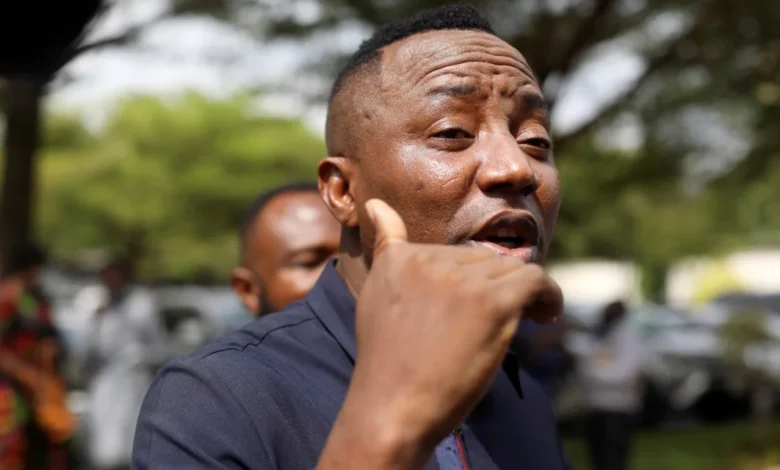
Adeyinka Olumide-Fusika (SAN), counsel to activist and politician, Omoyele Sowore, has urged the Department of State Services (DSS) to either drop the criminal charges against his client or transfer it to the Office of the Attorney-General of the Federation (AGF) for prosecution.
Olumide-Fusika, who is defending Sowore in his ongoing trial over alleged criminal defamation, cyberstalking, and incitement against President Bola Ahmed Tinubu, also questioned the appropriateness of DSS continuing to prosecute a case of such political sensitivity.
The secret service had accused Sowore of making false claims about President Tinubu, describing him as “a criminal” in posts published on his X and Facebook accounts.
But in a surprise move, the DSS director-general, Oluwatosin Ajayi, instructed the agency’s counsel, Akinola Kehinde (SAN), to seek a temporary suspension of the case until the conclusion of the 2027 elections.
Ajayi reportedly told the lawyer that the decision was to enable Sowore to participate in the electioneering processes without hindrance.
Olumide-Fusika, who spoke with journalists in Lagos, welcomed the decision, describing it as “reasonable” and worthy of praise, as it would allow Sowore to compete in the 2027 elections without being hindered by legal proceedings.
He, however, stated that, as a security agency responsible for internal security and intelligence, the DSS should not be seen as meddling in partisan politics.
“Based on this understanding, I respectfully suggest that the DSS either instruct their counsel to withdraw the charges altogether or, if that is not pursued, transfer the case to the Office of the Attorney-General of the Federation for prosecution,” the senior lawyer said.
Olumide-Fusika further observed that the DSS’s decision to halt the case had emphasised the importance of maintaining political neutrality and protecting its institutional integrity.
He argued that transferring the prosecution to the AGF or withdrawing it completely would shield the DSS from accusations of political bias and uphold its role as a professional security body.
He also expressed concern about how the suspension was communicated, noting that the defence team only learned of it through the media, rather than through official communication from the prosecution.
With nearly 40 years of active legal practice, the senior lawyer described the procedure as unusual and contrary to standard legal practice.
He maintained that, typically, when a case is scheduled for hearing and an adjournment is necessary, the opposing counsel is informed in advance, and the matter is then brought before the court for decision.
He argued that such decisions should not be announced via a press statement from a client, as the court, not a prosecuting agency, has authority over adjournments and the resumption of proceedings.
Olumide-Fusika also challenged the impression created by the DSS statement that trial would resume after the 2027 election, stating that once a matter is before a court, only the court can determine the schedule and conduct of proceedings.
He further asserted that any application for an adjournment should be made to the court, which would decide whether to grant it.
The lawyer warned that the DSS’s statement might give a false impression about the independence and functioning of Nigeria’s judiciary.
He urged government institutions to communicate more cautiously to avoid creating a distorted view of Nigeria’s justice system, especially in the eyes of the international community.
He said Nigerian institutions should not be undermined by statements implying security agencies can dictate the pace or timing of judicial proceedings.
Olumide-Fusika also reflected on earlier decisions to proceed with parts of Sowore’s trial during the court’s vacation, suggesting that these might have been linked to a desire to conclude proceedings before INEC released the timetable for the 2027 elections.