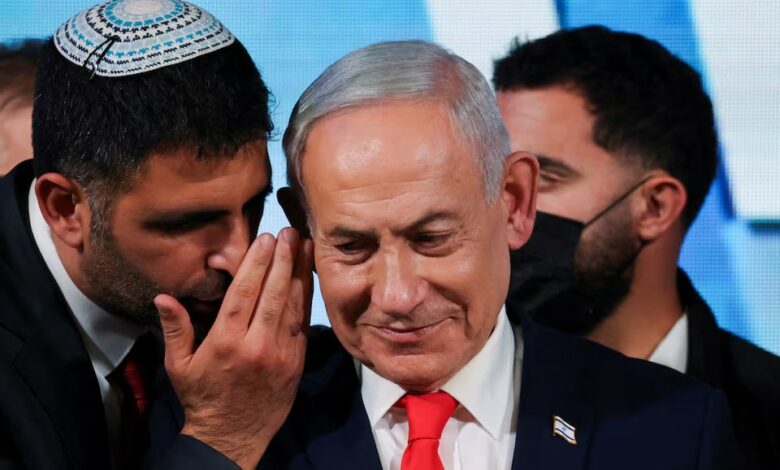
Israel’s political future remained uncertain on Wednesday as Prime Minister Benjamin Netanyahu and opposition challenger Gadi Eisenkot exchanged sharp remarks over national security and the legitimacy of the country’s leadership following the parliamentary election.
The contest has unfolded against a backdrop of regional tensions, particularly over Iran, as well as domestic disagreements about the government’s handling of security threats and its political future.
Netanyahu emphasised the need to confront what he described as an existential threat from Iran, linking Israel’s security priorities to cooperation with United States President Donald Trump.
“Israel faces a singular historical opportunity, together with our partner President Trump, to remove the existential threat of Iran once and for all. But ulterior motives must not divert us from this sacred mission,” he said.

The statement highlights the importance Netanyahu has attached to cooperation with Washington in addressing Iran’s regional influence and military capabilities.
However, his comments come amid continuing political divisions over the government’s security policies and the direction of Israel’s regional strategy.
READ RELATED STORY
Israel denies Netanyahu ordered diplomats to back Argentina’s Falklands claim
Prime Minister Burnham leaves door open for UK to rejoin European Union
Ukraine says Starlink still restricted after Trump claims limits lifted
EISENKOT CHALLENGES NETANYAHU’S AUTHORITY
Eisenkot, a former chief of the Israeli military, challenged Netanyahu’s political legitimacy, arguing that the prime minister could no longer claim the confidence of the Israeli public.
“Netanyahu is a caretaker prime minister, without a mandate or the people’s trust,” Eisenkot said, calling on the security establishment to “stand firm” against any attempt to put political interests ahead of Israel’s security.
His remarks reflected the opposition’s criticism of Netanyahu’s leadership and its concerns about the relationship between political considerations and national security decisions.
The exchange highlights the divisions facing Israeli politics as competing leaders seek to establish their authority and define the country’s priorities.
SECURITY AND DOMESTIC POLITICS DOMINATE DEBATE
Israel’s political debate has been shaped by the consequences of the Hamas-led attacks of October 7, 2023, the subsequent war in Gaza and wider regional confrontations involving Iran and other armed groups.
Netanyahu has consistently presented national security as a central priority, while his critics have questioned his government’s handling of the security failures surrounding the October 2023 attacks.
Other contentious issues include military-service exemptions for ultra-Orthodox Jewish men, judicial reforms and demands for greater accountability over the country’s security decisions.
These disputes have contributed to a political climate in which questions of leadership, public confidence and national security remain closely connected.