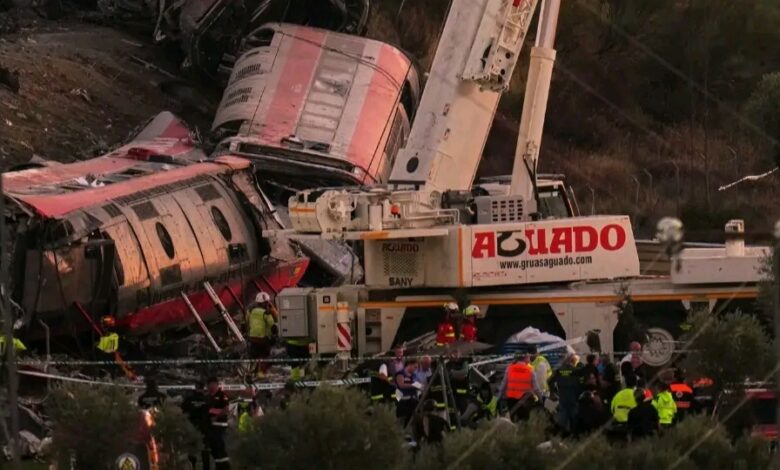
Spain has begun three days of national mourning after a high-speed train collision killed 68 people and injured scores and has intensified scrutiny of railway safety after a separate disaster killed 46 people in January. Investigators now face questions about why trains resumed running after an automatic control system failed.
The latest collision occurred on Wednesday morning in Castilla-La Mancha, south of Madrid, when a train operated by state-owned Renfe struck the rear of a stationary service belonging to private operator Iryo. Emergency crews worked through the night, using cranes to move twisted metal and search the wreckage along the Madrid-Seville railway corridor.
The scale of the disaster has left families searching for missing relatives while authorities work to identify victims. Spain’s Civil Guard has established offices in Madrid, Toledo, Cordoba and Seville to collect DNA samples from relatives. Red Cross teams are providing psychological support at a centre in Urda, where distressed families have gathered for information.
Survivors described scenes of violent impact and confusion. Josimar Medina, a 31-year-old Peruvian tourist, said he had been asleep aboard the Renfe train when the collision threw him into the air. Another passenger, Pablo Mejia, said a last-minute seat change may have saved his life.


A control failure raises difficult questions
Transport Minister Oscar Puente disclosed that an automatic control system had failed across a 69-kilometre stretch of track, prompting the suspension of train movements in the affected area.
However, Puente questioned the decision to resume services under circumstances he described as inexplicable. He said the Renfe train travelled about 25 kilometres before hitting the stationary Iryo service, adding that the control centre had sufficient time to detect and correct the problem.
His account places the handling of the technical failure at the centre of the emerging safety questions. Investigators will need to establish the sequence of events, the information available to railway controllers, and whether required safety procedures were followed before traffic resumed.
The minister’s statements do not, by themselves, establish the cause of the collision or determine individual responsibility. Those conclusions depend on the formal investigation and technical evidence.
READ RELATED STORY
Spain train crash kills at least 68 as Prime minister says ‘Whole country is grieving’
Drake loses $1.5 million FIFA World Cup bet as Spain defeats Argentina
Second disaster puts rail safeguards under scrutiny
The tragedy is particularly troubling because Spain suffered another fatal high-speed rail collision in January. Forty-six people died in that incident in Andalusia after a train derailed and crossed onto an adjacent track. That investigation is still ongoing.
The two disasters have renewed attention on the reliability of railway infrastructure, automatic protection systems and the decisions made when safety equipment fails. The latest collision also involved state and private operators, raising questions about coordination and oversight across Spain’s rail network.
The government faces pressure to explain what happened and demonstrate whether existing safeguards can prevent a recurrence. The investigation’s findings will be important not only for assigning responsibility but also for identifying any failures requiring urgent correction.
Meanwhile, the immediate priority is supporting bereaved families, identifying victims and treating survivors. Spain’s three-day mourning period honours those killed, but the lasting test will be whether the disasters produce clear answers and verifiable improvements in railway safety.
For More News Updates, Visit New Daily Prime News