Kalu Calls For Stronger Nigeria-EU Partnership to Change Narratives, Attract Investor

0
Torkwase Nyiekaa
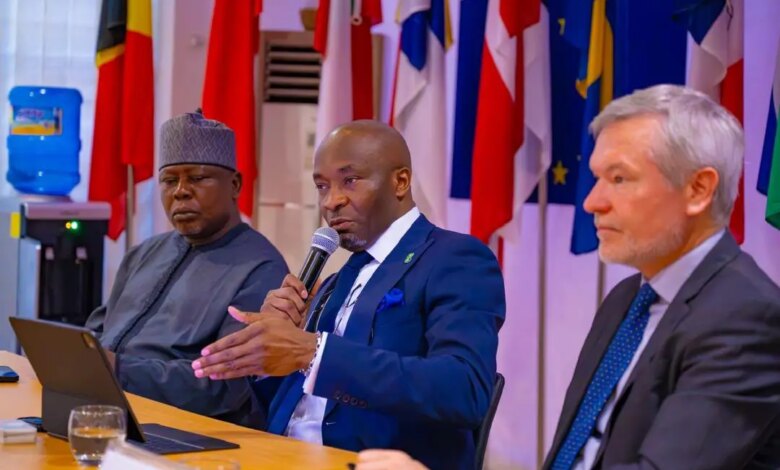
Deputy Speaker of the House of Representatives, Rt. Hon. Benjamin Okezie Kalu, has called for a stronger strategic partnership between Nigeria and the European Union (EU), urging both sides to develop a coordinated communication approach and deepen economic collaboration to improve Nigeria’s global image and attract greater foreign investment.
Kalu made the call during an interactive session with ambassadors of European Union member states in Nigeria, led by the EU Ambassador to Nigeria and ECOWAS, Gautier Mignot, in Abuja.

The engagement, which formed part of the Deputy Speaker’s ongoing parliamentary diplomacy initiatives, featured extensive discussions on Nigeria’s investment climate, tourism potential, governance reforms and opportunities for expanding economic cooperation between Nigeria and the EU.
Responding to concerns raised by the diplomats on Nigeria’s tourism assets, international image and business environment, Kalu argued that the country’s greatest challenge lies not necessarily in its realities but in the way those realities are communicated to the outside world.
He stressed that negative narratives often overshadow the country’s economic opportunities and security improvements, creating perceptions that discourage prospective investors.
“The investors’ confidence should be prioritized with regards to coming in to do business in Nigeria. The narrative, most times, does not reflect the actual situation in our country. You have lived here for a while. Nobody attacked you on the road. You moved freely, but the report that you have out there is different from the reality here.
“Sometimes, we handle our issues in a way that frightens outsiders, and also there is no deliberate effort by European journalists, for example, to come in to find out for themselves, not hearsay, but critically analysing the true position. So, we are not co-communicating. There is no co-communication between Nigeria and the European Union. We need to change our narrative,” Kalu said.
The Deputy Speaker noted that fostering investor confidence requires sustained engagement, balanced reporting and stronger institutional cooperation between Nigeria and its international partners.
He also advocated the adoption of the “near-shoring” model, describing it as a practical framework for industrial development in which countries with advanced technology and capital establish production closer to the source of raw materials.
According to him, such partnerships would enable Nigeria to move beyond the export of primary commodities and instead develop local industries capable of creating employment, expanding manufacturing and increasing value addition.
“In tourism, we are bundling it now, I must also mention the concept of near-shoring. As you know, this is where technology and finance are brought closer to raw materials. You have the finance and the technology. We have the raw materials, the metals and agro products. We have it.
“Why should my cocoa farm remain a cocoa farm? Can it become a chocolate factory? Because near-shoring says: bring your technology and I will bring my farm, so that we both benefit,” he said.
Kalu argued that closer collaboration between Nigeria and European businesses in agriculture, mining and manufacturing would not only strengthen local production but also reduce dependence on raw commodity exports, improve the balance of trade and generate employment opportunities capable of addressing youth unemployment and irregular migration.
He disclosed that the Federal Government is already taking steps to better coordinate the promotion of Nigeria’s tourism assets and investment opportunities in order to attract long-term partnerships with European investors.
The Deputy Speaker further explained that the engagement with the EU ambassadors aligns with his broader parliamentary diplomacy efforts as Chairman of the House of Representatives Constitution Review Committee. He said such interactions are intended to deepen dialogue with international partners on Nigeria’s constitutional reform process while strengthening legislative diplomacy and promoting democratic governance.
Nigeria and the European Union maintain longstanding relations spanning trade, development cooperation, governance support, security and climate initiatives. The EU remains one of Nigeria’s largest trading partners and development partners, providing support across sectors including education, healthcare, agriculture, electoral reforms and humanitarian interventions.
Analysts have increasingly argued that alongside domestic economic reforms, sustained efforts to improve Nigeria’s international perception and strengthen investor confidence will be critical to attracting the level of foreign direct investment needed to accelerate industrialisation and economic diversification.