0
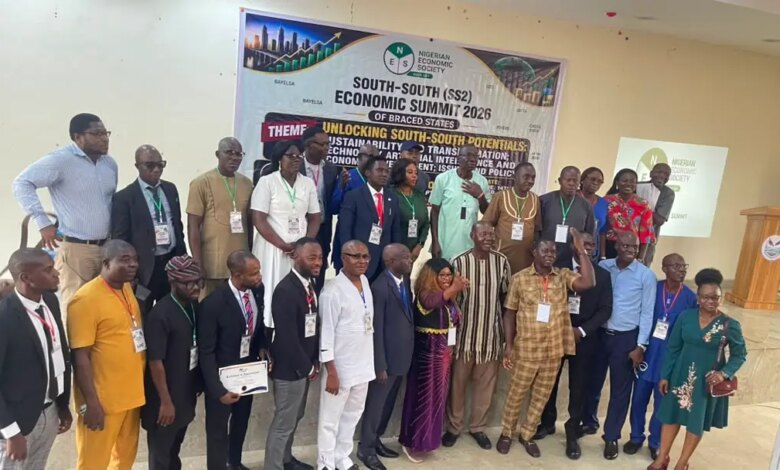
The Nigerian Economic Society, South-South Zone, NES-SSZ, has concluded its 2-day 2026 South-South Economic Summit of BRACED States at Dennis Osadebay University, Asaba, with a renewed call for evidence-based policies to drive sustainability, technology adoption, and inclusive growth across the region.
Daily Independent learnt this from the Coordinator, NES-SSZ during the summit as hosted by NES-Delta under the chairmanship of Dr. Richardson Kojo Edeme, held from Tuesday, July 14 to Wednesday, July 15, 2026, at the 500-Capacity Hall of Dennis Osadebay University, Asaba, Delta State Capital, event anchored on the theme: “Unlocking South-South Potentials: Sustainability and Transformation; Technology, Artificial Intelligence and Economic Development: Issues and Policy”.
Speaking during the event, UNIBEN Professor of Development & Health Economics & the South-South Coordinator of NES-SSZ, Professor Mercy Ada Anyiwe, while delivering her speech, commended the Management of Dennis Osadebay University, Asaba, and the leadership of NES- Delta State, Staff and students, and other participants for successfully hosting the event in the university and the massive attendance from NES-SSZ.


She stated further that the summit brought together economists, policymakers, academics, industry leaders, traditional rulers, and development partners to interrogate critical issues affecting the economic growth and transformation of the six BRACED States: Bayelsa, Rivers, Edo, Delta, Cross River, and Akwa Ibom.
Professor Anyiwe stated further that “the South-South region remains central to Nigeria’s economic future”. According to her, “This summit provides a strategic platform to unlock our regional potentials through evidence-based policy, technological innovation, and sustainable development. At the summit, no doubt, “Artificial Intelligence, green economy, and inclusive growth ‘ dominated NES-SSZ conversations as the group charted a new path for the BRACED states.”
Anyiwe, in her welcome address, stated that this is the 5th edition of the group’s summit. Professor Anyiwe traced the origin of the initiative to 2017 at the University of Port Harcourt with Prof. Godly Otto piloting, and its subsequent editions at Niger Delta University, Amassoma, University of Calabar, and University of Benin. She described the progression as “evidence of impactful growth, resilience, intellectual continuity, and shared commitment to regional and national development.”
The outgoing NES- South-South Coordinator, Prof Mercy Ada Anyiwe, had further observed that Nigeria’s economy is currently “learning how to walk on a tightrope while carrying a basket of eggs,” citing inflation, exchange rate volatility, youth unemployment, insecurity, and rising cost of living. She stressed that such realities make intellectual gatherings like this a necessity rather than a luxury.
Delivering a goodwill message at the summit on behalf of the National President of NES, Dr. Baba Yusuf Musa, the Chairman of NES Edo State Chapter, Dr. Francis Igberaese, had stated that the theme was apt and urgent.
He charged participants to produce “a clear set of sequenced recommendations with strong multiplier effects” that BRACED state governments can adopt, particularly in power, gas infrastructure, agro-industrial value chains, digital connectivity, and human capital development.
In the keynote address, Elder Godwin O. Ossai had urged economists and policymakers to embrace a paradigm shift in Nigeria’s economic governance.
He called for greater cooperation in economic governance of our nation among the government and social scientists – economists, sociologists, psychologists, political scientists, and psychiatrists in making inputs in designing national policies and our national needs – technical qualities, productivity, work culture and patriotism.
The summit featured robust panel discussions and paper presentations on nine sub-themes, including Artificial Intelligence in Learning and Research, Energy Transition and Green Economy, Digital Economy and Inclusiveness, Sub-National Budget and Tax Reform, Human Capital and Institutional Quality, Structural Transformation, and Illicit Financial Flows. Selected papers are to be published in the NES South-South Journal of Economics and Social Studies (SSJESS).
While commending the successful turnout and quality of deliberations, Dr. Richardson Kojo Edeme, Chairman of NES-Delta and host of the summit, expressed appreciation to all participants, sponsors, and partners.
He said the high level of engagement by scholars, students, and policymakers reflected the commitment of the South-South to intellectual leadership, and expressed optimism that the resolutions from Asaba would translate into concrete policies for the BRACED states.
Professor Anyiwe, in her closing remarks, urged citizens to embrace her 7-point agenda rooted in the 3Rs Model: Re-think, Re-Shift, and Re-Arrange by embracing productivity, honesty, functional institutions, accountability, and a less expensive system of governance as critical to rebuilding the region.
The communique of the summit emphasized the need to address security challenges to create an enabling environment for investment and economic activities in the region; and two the need to establish a robust framework for tracking progress and ensuring implementation of economic summits’ recommendations in the South-South region.
The Nigerian Economic Society, South-South Zone reaffirmed its commitment to driving research, policy dialogue, and collaboration for a prosperous and sustainable South-South Nigeria. Organizers said the outcomes of the summit would be forwarded to the governments of the BRACED states for consideration and implementation.